TL;DR
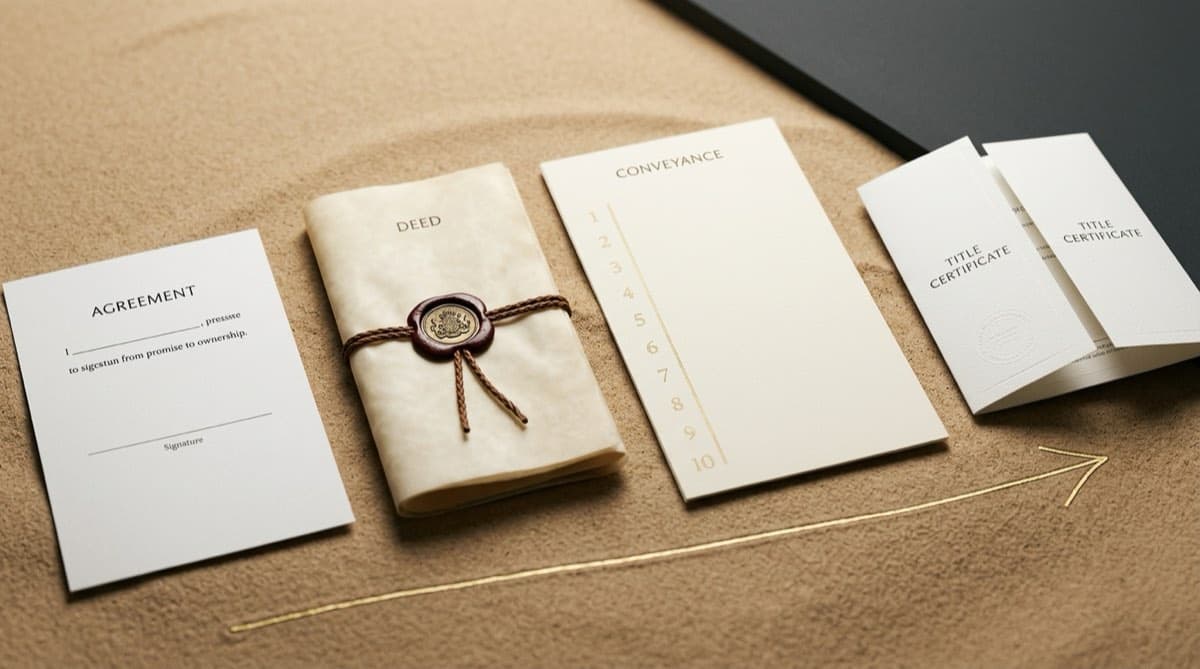
- An agreement to sell is a promise to transfer ownership in the future; a sale deed is the registered instrument that actually transfers it; conveyance deed is the umbrella term for any instrument that conveys title (sale, gift, exchange, partition, release); and title deed is any document that helps prove ownership. Only a registered sale or conveyance deed actually conveys title.
- A sale deed is a type of conveyance deed — the one used for a sale. So "sale deed vs conveyance deed" is mostly a category-versus-example question, not two opposing things.
- An agreement to sell creates only a contractual right (you can sue for specific performance); it does not make you the owner. Under Section 54 of the Transfer of Property Act, 1882, a contract for sale "does not, of itself, create any interest in or charge on" the property.
- A "title deed" is a function, not a single document: a registered sale deed, gift deed, partition deed, or grant order can all serve as title deeds. The chain of these over decades is what a Title Search Report verifies.
- For immovable property worth Rs 100 or more, transfer requires a registered instrument. An unregistered sale deed, a notarised "agreement," or a power of attorney does not pass ownership.
What is the difference between a sale deed, an agreement to sell, a conveyance deed and a title deed?
In one line: an agreement to sell promises a future transfer, a sale deed executes the transfer, conveyance deed is the broad category that a sale deed belongs to, and title deed is any document that evidences ownership. The single most important takeaway is that only a registered sale (or other conveyance) deed actually moves ownership from seller to buyer. Everything else is either a promise, a category label, or evidence.
Here is the at-a-glance comparison.
| Aspect | Agreement to Sell | Sale Deed | Conveyance Deed | Title Deed |
|---|---|---|---|---|
| What it is | A contract promising to sell in future on agreed terms | The instrument that completes the sale | Umbrella term for any instrument that transfers ownership | Any document that proves/evidences ownership |
| Transfers ownership? | No — promise only | Yes, on execution and registration | Yes (sale, gift, exchange, partition, etc.) | Reflects ownership; does not by itself transfer it |
| Governing law | Section 54, Transfer of Property Act, 1882 (contract for sale) | Section 54 TPA + Registration Act, 1908 | TPA + Registration Act | N/A — descriptive term |
| Registration | Optional in most states (but often advisable) | Mandatory for immovable property of Rs 100+ | Mandatory | The underlying deed must itself be registered |
| Stamp duty | Nominal (varies by state) | Full ad-valorem stamp duty on market value | Full ad-valorem stamp duty | Already paid on the underlying instrument |
| Rights it gives | Right to demand performance (sue for specific performance) | Full ownership, possession, right to transfer | Full ownership for that mode of transfer | Evidentiary proof in the title chain |
| Example | "I will sell you Survey No. 42 for Rs 1 crore within 90 days" | The executed, registered deed of sale of Survey No. 42 | A gift deed, partition deed, release deed, sale deed | The registered sale deed + RTC + khata together |
The myth to bust: a sale deed and a conveyance deed are not rivals. A sale deed is simply the species of conveyance deed used when the transfer is a sale. Likewise, a title deed is not a special standalone document you ask for at the registrar — it is whatever registered instrument (sale, gift, partition, grant) put the current owner on title.

What is an agreement to sell, and does it make you the owner?
An agreement to sell is a binding contract recording the terms on which a seller will transfer property to a buyer at a future date — price, payment schedule, possession date, and conditions to be met first (loan sanction, clear title, mutation, approvals). It does not make you the owner.
Under Section 54 of the Transfer of Property Act, 1882, a contract for the sale of immovable property "does not, of itself, create any interest in or charge on such property." It creates a right in personam — a right against the seller to complete the sale — enforceable through a suit for specific performance, not a right in rem over the land itself. Indian courts, including the Supreme Court, have repeatedly held that possession handed over under an agreement to sell does not confer ownership; a registered sale deed is still required.
Why agreements to sell still matter
- They lock in price and terms while you complete due diligence and arrange finance.
- They typically carry an advance/earnest money and a forfeiture or refund clause.
- A well-drafted agreement makes the seller's title warranties and the conditions precedent (e.g., "seller shall clear the Col. 11 encumbrance in the RTC before execution") legally enforceable.
This is exactly the window in which serious buyers run a full Title Search Report: you sign the agreement, then verify the title before paying the balance and executing the sale deed. Use the agreement-to-sale stage to make a clean title a condition of closing — not a hope.
What an agreement to sell cannot tell you
An agreement to sell tells you what the parties intend. It cannot tell you whether the seller actually owns the property, whether there is a mortgage on it, or whether litigation is pending. Those answers come from government records and a diligence sweep — never from the four corners of the contract.
What is a sale deed, and what makes it valid?
A sale deed is the legal instrument that actually transfers ownership of immovable property from seller (vendor) to buyer (vendee) in exchange for a price. It is the document that converts a promise into ownership. For immovable property valued at Rs 100 or more, the sale deed must be registered under the Registration Act, 1908 — an unregistered sale deed does not pass title and is largely inadmissible as evidence of the transfer.
For a sale deed to be valid and effective, it generally must be:
- In writing, identifying the parties, the property (with survey/khata/boundaries), and the consideration (price).
- Stamped with the correct ad-valorem stamp duty (a state subject; rates differ by state and sometimes by buyer category).
- Executed (signed) by the seller, ideally with witnesses, and the consideration paid as recorded.
- Registered at the jurisdictional Sub-Registrar's office, where it is recorded in the official register.
Once registered, the sale deed becomes the buyer's primary title deed and the basis for updating revenue/municipal records (mutation/khata transfer).
Sale deed vs sale agreement, in practice
People often say "I have an agreement" and assume they own the land. They do not. The agreement is the engagement; the registered sale deed is the marriage certificate. Two practical consequences:
- A General Power of Attorney (GPA) "sale" is not a sale. Selling through a GPA + agreement + will (the old "GPA sale" workaround) does not transfer ownership; the Supreme Court has held such transactions do not convey title. Insist on a registered conveyance.
- Registration is not optional. No matter how detailed or notarised, an unregistered instrument for a property worth Rs 100+ does not make you the owner.
What is a conveyance deed, and how is it different from a sale deed?
A conveyance deed is any registered instrument that conveys (transfers) ownership of property from one party to another. A sale deed is the most common type of conveyance deed — the one used when the transfer is a sale. So the difference is one of category versus example, not opposition.
Other common conveyance deeds include:
| Conveyance deed | When it is used |
|---|---|
| Sale deed | Transfer for a price (a sale) |
| Gift deed | Voluntary transfer without consideration (often within family) |
| Exchange deed | Two parties swap properties |
| Partition deed | Co-owners divide jointly held property into separate shares |
| Release / relinquishment deed | A co-owner gives up their share in favour of another |
| Settlement deed | Transfer (often to family) under a settlement |
All of these, when they relate to immovable property, must be stamped and registered. In housing, "conveyance deed" also appears in a special sense: when a builder/society finally conveys the land and common areas of an apartment project to the owners' association (sometimes called deemed conveyance if the builder delays). That is still a conveyance deed — just at the project level rather than the unit level.
Why the distinction matters in a title chain
When you trace 30 years of title, you will pass through several conveyance deeds of different kinds — a partition here, a gift there, sale deeds in between. Each is a link. A diligence team reads the mode of each transfer because the rules differ: a gift may be challenged on capacity or undue influence; a partition must cover all co-owners; a grant of government/inam land may carry alienation restrictions. The label on the instrument changes the questions you ask.
What is a title deed, and is it a separate document?
A title deed is not a distinct, separately issued document — it is any document that evidences ownership. The registered sale deed, gift deed, partition deed, or government grant order through which the current owner acquired the property is their title deed. "Show me the title deed" means "show me the registered instrument that put you on title."
Crucially, a title deed proves how ownership was acquired, but no single deed proves that the title is clear today. A registered sale deed shows that A bought from B — it does not tell you whether B truly owned it, whether the property is mortgaged, or whether a court has since clouded the title. That is why ownership in India is established by a chain and a cross-check, not by one piece of paper.
Title deed vs the records that support it
In Indian practice, several records work together. The deed is the instrument of transfer; the other records show what the government recognises and whether anyone else has a claim.
| Document/record | What it proves | What it does NOT prove |
|---|---|---|
| Registered sale/conveyance deed | A transfer happened and was registered | That the seller's own title was clean |
| Encumbrance Certificate (EC) | Registered transactions/charges over a period | Unregistered loans, oral claims, or court cases |
| RTC / Pahani (revenue land) | Recorded possession, crop, some encumbrance columns | Conclusive ownership |
| Khata (municipal) | Property is recorded for tax/civic purposes | Ownership |
| Mutation (khata transfer / dakhil kharij) | Records were updated after a transfer | Title itself |
Two common myths worth retiring: a khata does not prove ownership, and mutation does not prove ownership either. They are fiscal/administrative records that support a title story — the deed and the chain are what establish it.
So which document do you actually rely on — and how do you verify it?
You rely on the registered conveyance deed (usually a sale deed) as the instrument of transfer, but you trust it only after verifying the chain of title behind it and cross-checking it against government records. One deed is a claim; a verified chain is title.
A practical sequence:
- Agreement to sell — sign it with title, encumbrance, and approval clauses as conditions precedent. Pay only an advance.
- Run diligence on the chain — pull deeds and the Encumbrance Certificate from Kaveri Online, check the Bhoomi RTC for revenue land, confirm khata/mutation, and screen for mortgages (CERSAI) and litigation (eCourts, High Court, NCLT).
- Resolve flags — make the seller clear any encumbrance or defect before closing.
- Execute and register the sale deed — pay stamp duty, register at the Sub-Registrar, then update mutation/khata in your name.
For a step-by-step method, see how to verify property title before buying and the developer's due diligence checklist. Many problems that surface here are classic title defects — gaps in the chain, restricted-tenure land, or undischarged mortgages — which is precisely why a registered deed alone is never enough.
The honest limit: even a correctly registered sale deed cannot guarantee a clean title, because Indian registration is of the document, not a state guarantee of ownership. India does not have conclusive ("Torrens") title. This is why the diligence model that works is: AI gathers and drafts the report from the records; a lawyer reviews the chain and signs off.
Frequently asked questions
Is an agreement to sell the same as a sale deed? No. An agreement to sell is a promise to transfer ownership in the future on agreed terms; it creates a contractual right (you can sue for specific performance) but does not make you the owner. A sale deed is the instrument that actually transfers ownership, and for immovable property of Rs 100 or more it must be registered. The agreement is the engagement; the registered sale deed is what completes the transfer.
Is a sale deed a conveyance deed? Yes. A conveyance deed is the umbrella term for any instrument that transfers ownership — including sale, gift, exchange, partition, release, and settlement deeds. A sale deed is simply the conveyance deed used when the transfer is a sale. So they are not opposites: a sale deed is one specific type of conveyance deed.
What is the difference between a sale deed and a title deed? A sale deed is a specific instrument that transfers ownership through a sale. A "title deed" is a functional label for any document that evidences ownership — which can be a registered sale deed, gift deed, partition deed, or government grant. In other words, a sale deed often is the title deed, but a title deed can also be other kinds of registered instruments depending on how the owner acquired the property.
Does an unregistered sale deed transfer ownership? No. For immovable property worth Rs 100 or more, the Registration Act, 1908 requires the instrument to be registered. An unregistered sale deed does not pass title and is generally inadmissible as evidence of the transfer. The same applies to "GPA sales" (sale via power of attorney plus agreement and will) — courts have held these do not convey ownership. Insist on a registered conveyance deed.
Does a registered sale deed guarantee a clean title? No. A registered sale deed proves that a transfer was executed and recorded, but Indian registration records the document, not a guarantee of ownership — India does not use a conclusive (Torrens) title system. The seller's own title could be defective, the property could be mortgaged, or litigation could be pending. That is why you verify the full chain of title and cross-check government records (EC, RTC, khata, CERSAI, court searches), and why a lawyer reviews and signs the final title opinion.
When should I sign the agreement to sell versus the sale deed? Sign the agreement to sell first, with clear title, encumbrance, and approval conditions, and pay only an advance. Use that window to complete due diligence and arrange finance. Execute and register the sale deed only after the title is verified and any defects are cleared — that is the point at which you pay the balance and ownership actually transfers to you.
Continue reading

Does Khata Prove Ownership? A-Khata vs B-Khata vs e-Khata in Bangalore Explained
9 min read

Occupancy Certificate (OC) vs Completion Certificate (CC): What's the Difference and Why It Matters
9 min read

Can an NRI Buy Agricultural Land in India? FEMA & RBI Rules for 2026
7 min read

What Is a Title Search Report? A Developer's Guide to Property Due Diligence in India
14 min read
Automate your due diligence
Skip the manual portal work.
Deedwise automates everything in this article — across every connected portal — and delivers a complete Title Search Report in hours.
Request Access