
TL;DR
- Karnataka RTCs, mutation entries and many Kaveri deeds are written in Kannada, so non-Kannada buyers, NRIs and out-of-state lenders need both accurate translation and interpretation of legal terms — and the best modern approach is software that auto-translates each record into structured English fields while keeping the original Kannada alongside it for verification.
- A raw machine translation (Google Translate on a screenshot) is not diligence-grade: it mangles survey numbers, transliterates names inconsistently, and flattens domain terms like Khushki, Inam, gunta, kharab and Col.11 entries into meaningless English.
- The practical hierarchy: AI/structured translation for speed and coverage, a Kannada-reading paralegal for spot checks, and a certified translator only for documents headed to court or a foreign bank.
- What translation alone can never give you: legal interpretation. A correctly rendered "Sec.79A/79B" note or a tribunal mutation still has to be read by a lawyer who knows what it means for your title.
- Deedwise translates every Kannada record into English, preserves the original script next to the extracted data, and routes the output to a lawyer who reviews and signs the report.
How do non-Kannada buyers and out-of-state lenders translate and read Kannada land records?
There are three honest options, and serious diligence usually uses all three in layers. The fastest and most complete is AI-assisted structured translation — software that reads the Kannada record, renders it into English, and pulls the values into named fields (owner, area, patta type, encumbrance note). A human Kannada-reading paralegal then spot-checks the high-stakes fields. A certified human translator is reserved for documents that have to be filed in court or accepted by a lender or foreign authority, where a sworn translation is a procedural requirement.
The mistake to avoid is treating a one-shot machine translation of a screenshot as the finished product. Land records are dense, tabular, and full of specialised revenue vocabulary. A general translator does not know that "ಖುಷ್ಕಿ" (Khushki) is dry/unirrigated land, that "ಗುಂಟೆ" (gunta) is 1/40th of an acre, or that a number in Column 11 is an encumbrance and not a phone number. Getting the words right is necessary but not sufficient — you also need the record's structure and legal meaning preserved.
| Approach | Best for | Speed | Cost (indicative) | Limit |
|---|---|---|---|---|
| Google Translate / phone camera | A rough first read of a single page | Seconds | Free | Breaks tables, mangles numbers/names, no legal context |
| AI structured translation (e.g. Deedwise) | Full diligence — RTC, mutations, EC deeds at scale | Minutes | Part of a report fee | Still needs a lawyer to interpret findings |
| Kannada-reading paralegal | Spot-checking critical fields, judgement calls | Hours | Hourly | Doesn't scale to dozens of deeds; varies by person |
| Certified / sworn translator | Court filings, foreign-bank or NRI compliance | Days | Highest; priced per document | Slow and expensive for routine diligence |
Whatever route you take, this is part of a larger workflow. Translation is one input into a title search report, not a substitute for it.
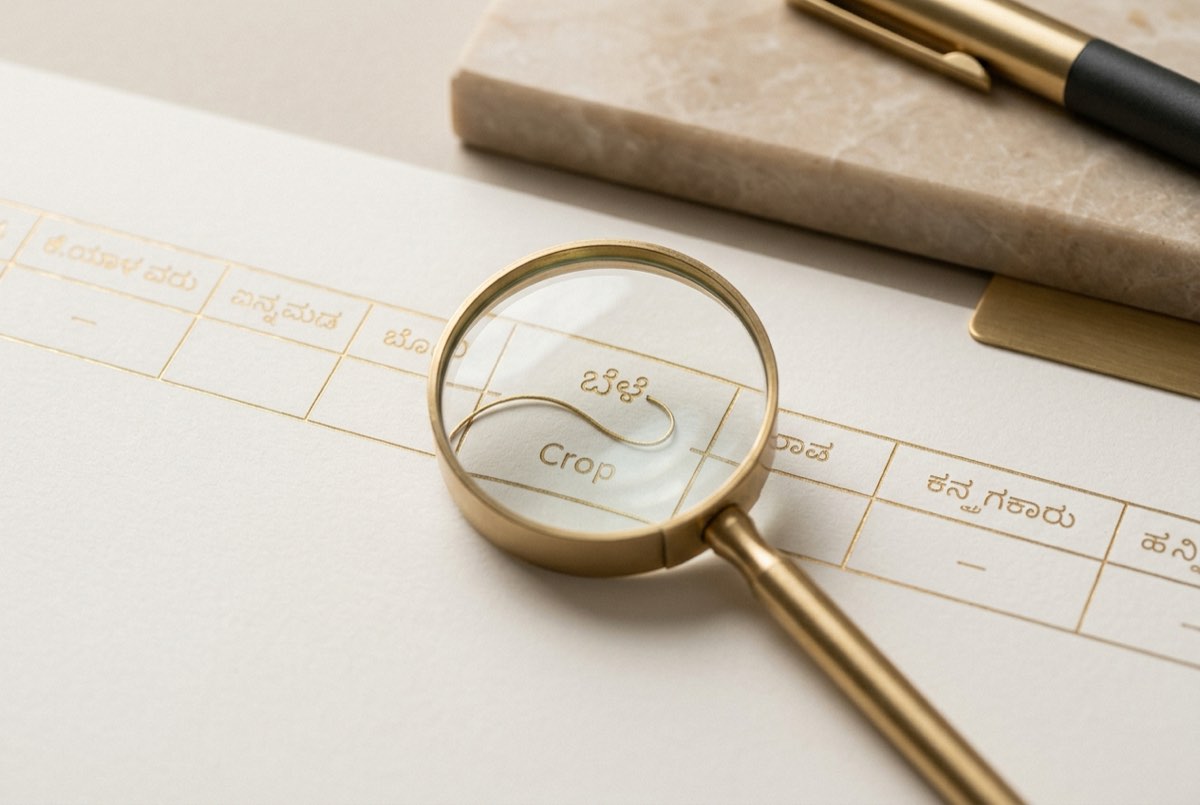
Which Karnataka land records are in Kannada, and which are not?
Most of the records that decide your title are in Kannada — but not uniformly. Knowing which is which tells you where translation effort actually matters.
- Bhoomi RTC / Pahani — the body of the record (owner names in Column 4, land nature in Column 3, the all-important Column 11 encumbrances, and the free-text remarks in the last column) is in Kannada. The numeric columns and the survey number are language-neutral. The remarks column is where the worst surprises hide, often in shorthand. For a column-by-column walkthrough, see the Bhoomi RTC guide.
- Mutation register (MR) extracts — heavily Kannada. The narrative of how ownership changed (sale, inheritance, partition, tribunal order) is exactly what you most need translated and interpreted.
- Kaveri deeds and the Encumbrance Certificate — mixed. The Kaveri 2.0 EC index and many fields are in English, but the underlying registered instruments (sale deeds, GPAs, mortgage deeds) are frequently in Kannada, especially older ones. See Kaveri Online 2.0 for ECs and deeds.
- K-GIS / spatial data — mostly numeric and English attributes; little translation needed.
- Court and tribunal records — eCourts case status is largely English; orders and RCCMS (revenue court) remarks can be Kannada.
So the translation problem concentrates in three places: the RTC remarks and Column 11, the mutation history, and older registered deeds. Those are also the three places where title defects live.
How does AI translate a Kannada RTC or deed into structured English?
Good AI translation for land records does two jobs at once: it renders the prose into English and it keeps the document's structure and original script intact so a human can verify it. A simple "paste the text, get English back" tool does neither reliably.
Here is what a well-built pipeline does, step by step — and it mirrors how Deedwise processes a record:
- Detect the script. The system checks whether the page actually contains Kannada (Unicode block U+0C80–U+0CFF) before spending any effort; pages already in English are skipped.
- Translate cell by cell, not page by page. Instead of handing the whole page to a model and hoping the table survives, the structure (every table cell, heading and paragraph) is held in code and only the inner text is sent for translation. The layout — rows, columns, the multi-column RTC grid — cannot be lost, because the model never touches the markup.
- Preserve verbatim what must not change. Survey numbers, hissa suffixes, dates, registration/CD numbers, latitudes and longitudes, and proper nouns (place and person names) are passed through unchanged rather than translated or re-spelled. This is the single biggest failure point of consumer tools, which happily "translate" a survey number into garbage.
- Extract into named fields. Beyond free-text English, the values are pulled into structured fields a lawyer can scan: owner names, patta type, area in acres and guntas, Column 11 encumbrance text, kharab (waste) area, and — for deeds — instrument type, parties, consideration amount, and SRO. For mutations, each entry is broken into from-party, to-party, type and approval status.
- Keep the original alongside. The Kannada source and the English output are stored side by side (in Deedwise, an
originaland atranslatedview of every document), so a reviewer can always compare against the source rather than trusting a black box. - Route to a human. The translated, structured record feeds the four-pillar report, which a lawyer reviews and signs. AI gathers and drafts; a lawyer decides.
The reason this matters commercially is coverage. A Kannada-reading paralegal can read one deed carefully; the same person cannot carefully read a 30-year chain of mutations plus a stack of registered instruments for a multi-survey-number project before your exclusivity expires. Structured translation does the bulk read so the humans spend their time on judgement, not transliteration.
What land-record terms get lost in plain translation?
Plenty — and these are the terms that change a deal. A generic translator will render the word and lose the meaning. Here are the ones diligence teams watch for, with what they actually signify.
| Kannada / revenue term | Naive translation | What it actually means |
|---|---|---|
| Khushki | "dry" | Dry / unirrigated land classification — affects valuation and conversion |
| Tari | "wet" | Wet / irrigated land |
| Patta: Sarkari vs Inam | "government / grant" | Tenure type — Inam and granted lands can carry transfer restrictions |
| Gunta | (often dropped) | Area unit; 40 guntas = 1 acre — mis-handling distorts extent |
| Kharab (A and B) | "waste" | Non-cultivable/government waste area; reduces net saleable area |
| Col.11 / Saguvali entry | a number | Revenue-level encumbrance, attachment or government due |
| Sec.79A / 79B note | meaningless | Land Reforms Act restriction flag (see below) |
| Mutation: "varadi" / tribunal order | "report" | How ownership changed — sale, inheritance, or a contested tribunal mutation |
| PTCL reference | meaningless | Possible restriction under the Karnataka PTCL Act, 1978 on granted-caste lands |
Get any of these wrong and you can misjudge how much land you are actually buying, or miss a restriction that makes the sale voidable. These map directly onto the classic title defects in Indian real estate — most of which first appear as a single line of Kannada in a remarks column.
One note on Sec.79A/79B that confuses out-of-state buyers
You may see references to Sections 79A and 79B of the Karnataka Land Reforms Act, 1961 in older records. Those sections — which once barred non-agriculturists from buying farmland — were repealed by a 2020 amendment, and as of 2026 that repeal remains in force, so a non-farmer can hold agricultural land. But a historical 79A/79B entry in a record still matters: it can signal a past inquiry, a conditional grant, or a parallel PTCL question that a translation alone will never explain. This is exactly where you stop translating and start asking a lawyer.
What can translation NOT tell you?
This is the honest limit, and it is the whole reason Deedwise keeps a lawyer in the loop. Translation converts language; it does not confer legal judgement, and it cannot fix a flawed source.
- It is not interpretation. A perfectly translated tribunal mutation or "stay order" entry still needs a lawyer to decide whether your chain of title is clear, conditional or defective. The word being in English does not tell you whether to buy.
- It cannot correct a wrong source. If the village accountant mis-recorded an owner or the OCR misread a faint stamp, a faithful translation faithfully reproduces the error. That is why the original script is kept alongside — so a human can catch it.
- Handwriting and faint scans degrade accuracy. Old deeds, smudged stamps and handwritten margins are the hardest cases for any system, human or machine. Confidence varies, and low-confidence pages should be flagged for manual review, not trusted blindly.
- A translation is not a certified translation. For a court filing or a lender's compliance file, you usually need a sworn translation from an authorised translator regardless of how good the AI output is.
- It does not resolve conflicts between records. Translation gives you the English of each document; reconciling an RTC owner against the latest Kaveri deed against a CERSAI charge is analysis, not language work — and it belongs in a full due diligence checklist.
This limit is precisely why the comparison between AI and a lawyer for title verification lands where it does: use AI to gather and draft, use a lawyer to interpret and sign.
Frequently asked questions
Can I just use Google Translate on a photo of my RTC? For a rough idea of what a page says, yes. For diligence, no. Phone-camera translation routinely breaks the RTC's table layout, transliterates survey numbers and owner names inconsistently, and renders revenue terms like Khushki, gunta, kharab and Column 11 entries into English words that lose their legal meaning. Use it to orient yourself, never to make a buying decision.
How accurate is AI translation of Kannada land records? On clean, machine-generated records (a digital Bhoomi RTC or a Kaveri EC index), high-quality structured translation is reliable enough to drive a diligence report, especially when numbers and proper nouns are preserved verbatim and the original is kept for comparison. Accuracy drops on handwritten deeds, faint stamps and old scans — so a good pipeline flags low-confidence pages for human review rather than presenting everything with false certainty.
Do I still need a certified translator? Sometimes. For routine diligence, structured English plus a lawyer's interpretation is what you act on. But if a document has to be filed in court, or accepted by a bank or a foreign authority (common for NRI buyers and out-of-state lenders), you typically need a sworn translation from an authorised translator. Treat that as a separate, procedural step — not your primary read of the record.
Why does Deedwise keep the original Kannada next to the English? So findings can be verified, not just trusted. A translation can faithfully reproduce an error in the underlying record, and machine output can occasionally slip on a faint or handwritten field. Storing the original script beside the extracted English lets a reviewing lawyer compare against the source, which is the foundation of an auditable, signable report.
Which Kannada records matter most to translate first? The RTC remarks column and Column 11, the full mutation history, and older registered deeds on Kaveri. These three are both the most likely to be in Kannada and the most likely to hide a title defect — a tribunal mutation, an undisclosed encumbrance, or a restriction note. Spatial (K-GIS) and most eCourts status data need little translation.
Does translating the records replace a lawyer's title opinion? No. Translation and structured extraction tell you what the records say; they do not tell you whether your title is clear. Deedwise's model is deliberate: AI scrapes, translates and drafts the four-pillar report, and a qualified lawyer reviews the evidence and signs off. The English text is the input to the legal judgement, not the judgement itself.
Continue reading


Automate your due diligence
Skip the manual portal work.
Deedwise automates everything in this article — across every connected portal — and delivers a complete Title Search Report in hours.
Request Access