TL;DR
- Before signing a JDA, verify the developer's RERA registration and complaint history, their actual delivery track record, their financial capacity, and any active litigation (eCourts, the relevant High Court, and NCLT/IBC) — because if the developer stalls, the landowner bears the risk while their land sits encumbered for years.
- The single highest-value check is RERA: pull the promoter's profile on the state RERA portal, read every complaint and order, and confirm their past projects actually completed on the timelines they promised.
- An NCLT/IBC search matters more than people think — if a developer is dragged into insolvency mid-project, your contributed land can get caught up in the corporate insolvency resolution process.
- Protect yourself in the document itself: register the JDA, insist on a registered (not notarised) Power of Attorney, and fix area-sharing, hard timelines with penalties, and a clean default-and-exit clause that lets you take the land back.
- Run title diligence on your own land too — a developer's lender will, and a clean title is your leverage at the negotiating table.
How do I verify a developer or builder's track record before signing a JDA?
Verifying a developer before a Joint Development Agreement comes down to four parallel investigations: their RERA standing (registration plus complaint and order history), their delivery record (did past projects finish, and on time), their financial capacity (can they actually fund construction), and their litigation exposure (court cases and insolvency proceedings). You run all four before you sign, and you bake the findings into the contract terms.
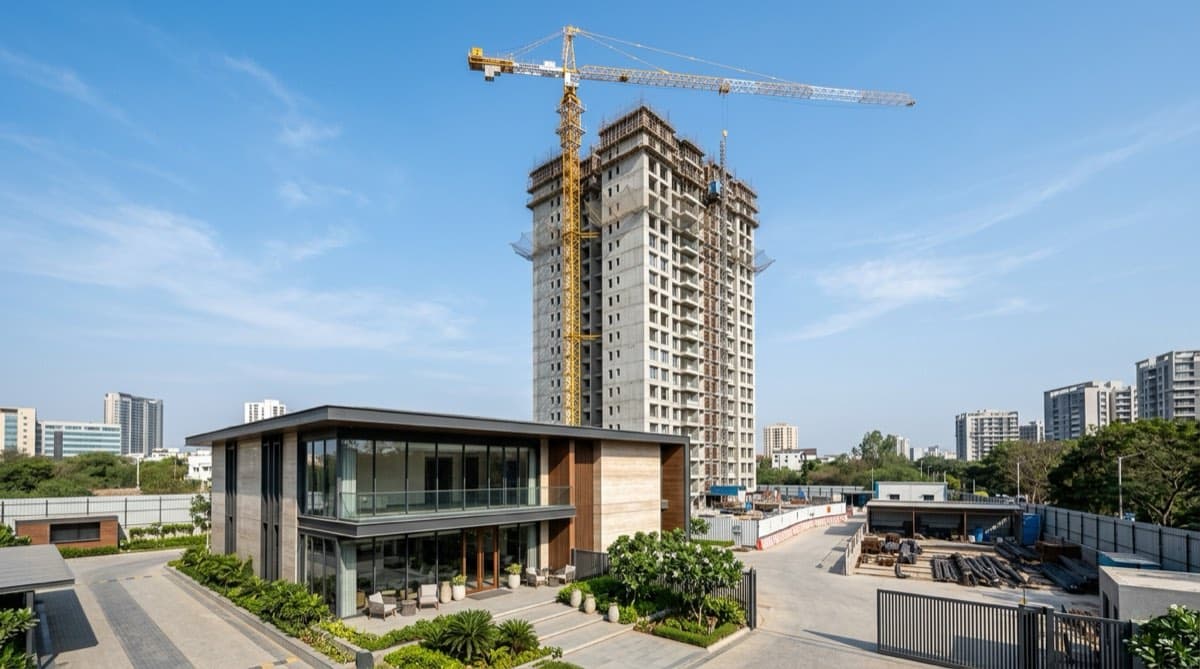
A JDA is not like selling your land. You hand over possession and development rights, the developer builds, and you split the constructed area or revenue. The catch: the project can take three to six years, your land is committed the whole time, and if the developer underperforms you are the one left holding a half-built asset and a clouded title. The diligence below is what protects you.
This guide is written from the landowner's point of view. If you are on the developer's side, the companion piece on title due diligence to run before signing a JDA or MoU covers the land-side checks you should expect a landowner to demand.
Why the landowner carries the risk
The structural reality of a JDA is asymmetric. The developer can walk away from a stalled project and move capital to the next one. You cannot move your land. If the project stops, your parcel is tied up under a registered development agreement and a Power of Attorney, often with the developer's construction loan registered against it. Untangling that can take litigation measured in years. That asymmetry is exactly why your pre-signing diligence and your exit clause matter more than the glossy brochure.
How do I check a developer's RERA registration and complaint history?
Go to your state's RERA portal, search the promoter and their projects, and read both the registration details and every complaint and order filed against them. This is the most information-dense, free, and authoritative check available, so do it first.
In Karnataka the portal is rera.karnataka.gov.in (K-RERA). Other states run their own — MahaRERA, UP-RERA, TG-RERA (Telangana), and so on — but the mechanics are similar.
What to search and what to read:
| Step | What to look at | What a red flag looks like |
|---|---|---|
| Search by promoter name | All projects registered under that promoter or its group entities | Projects registered under many shell-like SPVs with no track record |
| Open a registered project | Registration date, proposed completion date, validity, promoter PAN, sanctioned plan | Completion dates repeatedly extended; expired registration |
| Quarterly updates (QPR) | Most recent quarterly progress report | No QPR filed in the last quarter — a sign the developer ignores compliance |
| Complaints tab | Pending and disposed complaints, and the RERA authority's orders | A pattern of complaints about delays, refunds, or possession |
| Penalty and recovery orders | Whether RERA has ordered refunds or penalties the developer hasn't paid | Unpaid recovery warrants — strong evidence of distress |
One complaint is noise; many real estate companies have one. A pattern is signal — repeated delay complaints, refund orders the developer is contesting or not paying, or registrations that keep lapsing tell you how this developer behaves when a project goes wrong. Read the actual orders, not just the count.
What RERA cannot tell you
RERA is powerful but it is not a credit report. The portal will not show you the developer's bank balance, their other off-the-books liabilities, disputes that were settled privately, or litigation that never reached the RERA authority (most ordinary civil and criminal cases do not). It also reflects only what the promoter filed — a developer in trouble often simply stops updating. Treat RERA as the starting point, not the whole picture.
How do I check the developer's delivery record and financial capacity?
Verify that past projects were actually completed and handed over — not just launched — and form a realistic view of whether the developer can fund construction without your project becoming a cash-flow casualty.
Delivery record:
- Pull the developer's list of completed projects (from RERA, their website, and independent listing portals) and physically verify a few. Visit or have someone visit. A "completed" project that is occupied, with an occupancy certificate (OC) issued, is real. A project still showing construction years after its promised date is the truth the brochure hides.
- Cross-check promised vs. actual timelines on past RERA projects. A developer who delivered three projects each two years late will likely deliver yours late too.
- Talk to landowners from the developer's previous JDAs if you can find them. Did they get their share on time? Was the build quality as promised? Were there disputes over area or specification?
Financial capacity:
- For a company or LLP, you can pull filings from the MCA (Ministry of Corporate Affairs) portal — financial statements, charges registered against the company, and director details. Heavy registered charges or persistently negative net worth are warnings.
- Check for registered charges/mortgages the developer's lender may place — this ties directly to the litigation and insolvency check below.
- A developer who needs your land monetised immediately to fund construction is riskier than one with independent capital. Understand where the construction money is coming from.
If you are evaluating several landholdings or several developer offers at once, run these checks consistently across each — the same discipline developers themselves apply to a land pipeline. A repeatable checklist beats ad-hoc judgment.
How do I check a developer for litigation and NCLT/insolvency proceedings?
Search the courts and the insolvency tribunal directly: eCourts for civil and criminal cases, the relevant High Court for writs and appeals, and the NCLT for any company petition under the Insolvency and Bankruptcy Code (IBC), 2016. This is the check most landowners skip and the one that can hurt the most.
Why NCLT/IBC is the dangerous one
If a financial or operational creditor drags the developer's company into insolvency, the National Company Law Tribunal can admit a Corporate Insolvency Resolution Process (CIRP). Once CIRP begins, a moratorium freezes proceedings against the company and a resolution professional takes control of its assets. A landowner whose parcel is entangled in the developer's project can find their interest caught in that process — fighting alongside banks and other creditors to extract their land. Checking whether the developer (or its group entities) faces NCLT petitions before you sign is far cheaper than discovering it afterward.
Where to search:
| Forum | What it covers | What to search |
|---|---|---|
| eCourts (District & subordinate courts) | Civil suits, criminal complaints | Developer's company name, key directors, project SPV |
| State High Court services | Writs, company matters, appeals | Same names; also disputes with authorities |
| NCLT | IBC insolvency petitions against companies | Company name and CIN of the developer and group SPVs |
| Consumer commissions | Buyer disputes (delays, defects, refunds) | Developer and project names |
Search the exact corporate names, not just the brand. Big developers operate through a web of project-specific SPVs (special purpose vehicles), and litigation often sits on the SPV, not the flagship brand. A clean "Brand X Developers" search means little if the project will run through "Brand X Greenfield Projects Pvt Ltd."
This litigation sweep is exactly the Litigation pillar of a proper Title Search Report — and it is one of the four pillars (Ownership, Land, Encumbrance, Litigation) that any serious diligence covers. Platforms like Deedwise automate this sweep across eCourts, the Karnataka High Court, and NCLT, then a lawyer reviews and signs off on the findings — because a name-match alone can throw false positives that need human judgment to clear.
What a litigation search cannot tell you
Court portals are only as good as their data entry, and case records are often filed under abbreviated, misspelt, or inconsistent party names — so a clean search is not a guarantee of no litigation. Settled or pre-litigation disputes never appear. And a name match is not proof: "S. Kumar" the developer may not be "S. Kumar" the defendant in an unrelated case. This is precisely why machine-gathered results need a lawyer's eye before you rely on them.
How do I protect myself in the JDA document itself?
Diligence tells you who you are dealing with; the contract is what protects you when things go wrong. Five things are non-negotiable from the landowner's side.
- Register the JDA. A development agreement that transfers possession and development rights should be registered under the Registration Act, 1908 and stamped per your state's stamp duty. An unregistered JDA is weak evidence and exposes you. Once registered, it shows up on encumbrance searches via portals like Kaveri Online 2.0 in Karnataka — which protects you and warns off bad actors.
- Insist on a registered Power of Attorney, not a notarised one. You will give the developer a POA to obtain approvals and, often, to sell the developer's share. Make it registered, specific (limited to clearly listed acts), and revocable on default. A broad, notarised, irrevocable POA is how landowners lose control.
- Fix the area/revenue sharing precisely. Spell out the exact ratio, which specific units or floors are yours (not just a percentage), the carpet-area basis, specifications, and the amenities. Vague sharing language is the most common source of JDA disputes.
- Hard timelines with teeth. Define the start date, completion date, and grace period, and attach penalties for delay plus a clear consequence for prolonged default. "Best efforts" is meaningless.
- A default-and-exit clause that returns the land. The clause must let you terminate and recover possession and your title if the developer abandons the project or breaches materially — and it should address what happens to any construction loan the developer registered against the land. This is your single most important protection. Tie the refundable security deposit and any interest-free deposit to it.
The deeper, step-by-step list of clauses and the title-side checks that sit alongside them are in the developer's property due diligence checklist.
Don't forget the diligence on your own land
A serious developer — and certainly their lender — will run a full title search on your parcel before committing. Get ahead of it. A clean, well-documented title is your leverage: it speeds the deal, justifies a better share, and avoids last-minute renegotiation when the developer's lawyer finds a gap.
In Karnataka that means a clean 30-year chain of title, current and historical RTC/Pahani records via Bhoomi, mutation history, and a check on whether old issues like PTCL (granted-land) restrictions or inam/tenancy claims touch the parcel. Note that the bar on non-agriculturists buying farmland under Sections 79A and 79B of the Karnataka Land Reforms Act was repealed in 2020 and remains repealed as of 2026 (despite periodic political talk of restoring it) — but conversion (DC conversion) and zoning rules still govern what can be built. Knowing your land's title defects before the developer does keeps you in control; the common ones are catalogued in 7 common title defects in Indian real estate.
Frequently asked questions
What is the single most important check before signing a JDA?
The developer's RERA record, followed closely by an NCLT/insolvency check. RERA shows you registration status, completion timelines, and complaint and order history for free on the state portal. The NCLT/IBC check matters because if the developer's company enters insolvency mid-project, your land can get caught in the corporate insolvency resolution process. Do both before you sign, and read the actual RERA orders and any court records — not just the counts.
Why does a landowner bear more risk than the developer in a JDA?
Because the developer can abandon a stalled project and redeploy capital, while the landowner cannot move their land. Once a JDA and Power of Attorney are registered, the parcel is committed — often with the developer's construction loan registered against it. If the project stalls, the landowner faces years of litigation to recover clean possession and title. That asymmetry is why a strong default-and-exit clause is the landowner's most important protection.
Should the Power of Attorney in a JDA be registered or notarised?
Registered, and as narrow as possible. A registered POA is far stronger evidence and harder to misuse than a notarised one. Keep it specific to clearly listed acts (obtaining approvals, dealing only with the developer's share), and make it revocable if the developer defaults. A broad, irrevocable, notarised POA is a common way landowners lose control of their land.
How do I check if a developer has cases against it in court or NCLT?
Search eCourts for civil and criminal cases, your state High Court's case services for writs and appeals, and the NCLT for insolvency petitions under the IBC. Search the exact corporate names — the flagship brand and the project-specific SPVs — not just the brand name, since litigation often sits on the SPV. Remember that court data is inconsistently entered, so a clean search is reassuring but not conclusive, and a name match is not proof of identity; have a lawyer confirm any hits.
Do I need to run title diligence on my own land before a JDA?
Yes. The developer's lender will run a full title search before funding construction, so a clean, documented title is your leverage to close faster and on better terms. In Karnataka, verify a 30-year chain of title, current and historical Bhoomi RTC records, mutation history, encumbrances via Kaveri, and any PTCL or tenancy restrictions. Knowing your own title defects before the developer's lawyer does keeps you in control of the negotiation.
Is the JDA itself something I need to register?
Yes. A JDA that transfers possession and development rights should be registered under the Registration Act, 1908 and stamped per your state's stamp duty rules. An unregistered JDA is weak evidence in a dispute and leaves you exposed. Once registered, it also appears in encumbrance searches, which protects your interest and deters bad actors. Always pair the registered JDA with a registered (not notarised) Power of Attorney.
Continue reading

What Title Due Diligence to Run Before Signing a JDA or MoU (Developer Guide)
10 min read

What Is a Joint Development Agreement (JDA) vs a Joint Venture for Land Developers?
9 min read

NRI Property Due Diligence: How to Verify Title Remotely Without Flying to India
10 min read

The Developer's Property Due Diligence Checklist: 30+ Checks Before You Sign the MoU
13 min read
Automate your due diligence
Skip the manual portal work.
Deedwise automates everything in this article — across every connected portal — and delivers a complete Title Search Report in hours.
Request Access