TL;DR
- An 11E sketch is the survey-department drawing (issued in Form 11E) that shows the exact boundary of a sub-divided portion of a survey number — and in Karnataka you cannot register the sale of part of a parcel without it; the FMB (Field Measurement Book) is the authoritative plot-level survey map, and any mismatch between the 11E/FMB and your sale deed signals a boundary or extent dispute.
- Phodi (also spelled Podi) is the sub-division process that splits one survey number into independent sub-numbers (e.g., 45/1, 45/2); the 11E sketch is the pre-mutation step that makes a partial sale registrable, and Tatkal Phodi is the fast-track paid version.
- An 11E sketch is not a title document and not a substitute for a full Phodi — it confirms where a boundary runs, not who owns the land or whether the title is clear.
- You apply for and view 11E, Phodi, and alienation sketches on Mojini (the SSLR survey portal); the FMB, Tippani, Akarband, and village map (Atlas) are the older survey records that the new sketch must reconcile with.
- A senior diligence team treats the 11E/FMB as the spatial cross-check on the deed and the RTC — Deedwise surfaces extent mismatches automatically, but a lawyer reviews and signs the final opinion.
What is an 11E sketch, Phodi, and FMB in Karnataka — and when do you need one?
An 11E sketch is a survey sketch, issued by Karnataka's survey department in Form 11E, that shows the precise boundary and extent of a specific sub-divided portion of a survey number. You need it whenever you are buying or selling part of a survey number (a hissa) rather than the whole parcel — because the Sub-Registrar will not register a sale deed for a portion without it.
These three terms describe related but distinct things, and they are constantly confused:
| Term | What it is | When it matters |
|---|---|---|
| 11E sketch (Form 11E) | A pre-mutation sketch showing the boundary of the portion being carved out of a survey number | Required to register a partial sale, gift, or division of a survey number |
| Phodi / Podi | The administrative sub-division process that splits one survey number into independent sub-numbers (e.g., 45/1, 45/2) | Needed to make the split permanent — each new hissa gets its own RTC and survey records |
| FMB (Field Measurement Book) | The authoritative, plot-level survey map with measurements, offsets, and boundary detail for a survey number or hissa | The reference document for confirming the actual surveyed extent and boundary on the ground |
The simplest way to hold it in your head: Phodi is the act of dividing, the 11E sketch is the drawing that lets you register that division, and the FMB is the master survey map the new sketch must agree with.
How they fit together in a partial sale
Say a seller owns Survey No. 45, total extent 4 acres, and wants to sell you 1 acre. You cannot simply register a deed for "1 acre out of Survey No. 45." The flow is:
- The seller (or the parties jointly) applies to the survey department — today via Mojini — for an 11E sketch for the 1-acre portion. A licensed surveyor measures the portion against the existing FMB and Tippani and produces the sketch in Form 11E.
- With the 11E sketch in hand, the sale deed for the demarcated portion can be registered on Kaveri 2.0.
- After registration and mutation, the Phodi (sub-division) is completed so the 1 acre becomes its own sub-survey number (e.g., 45/2) with its own RTC. A separate Phodi sketch is generated once the sub-division mutation is recorded in Bhoomi.
If you are buying the whole survey number, you generally do not need a fresh 11E — but you should still pull the existing FMB to confirm the boundary and extent match the deed and the RTC's Column 2 area.
What is the FMB and how is it different from the 11E sketch?
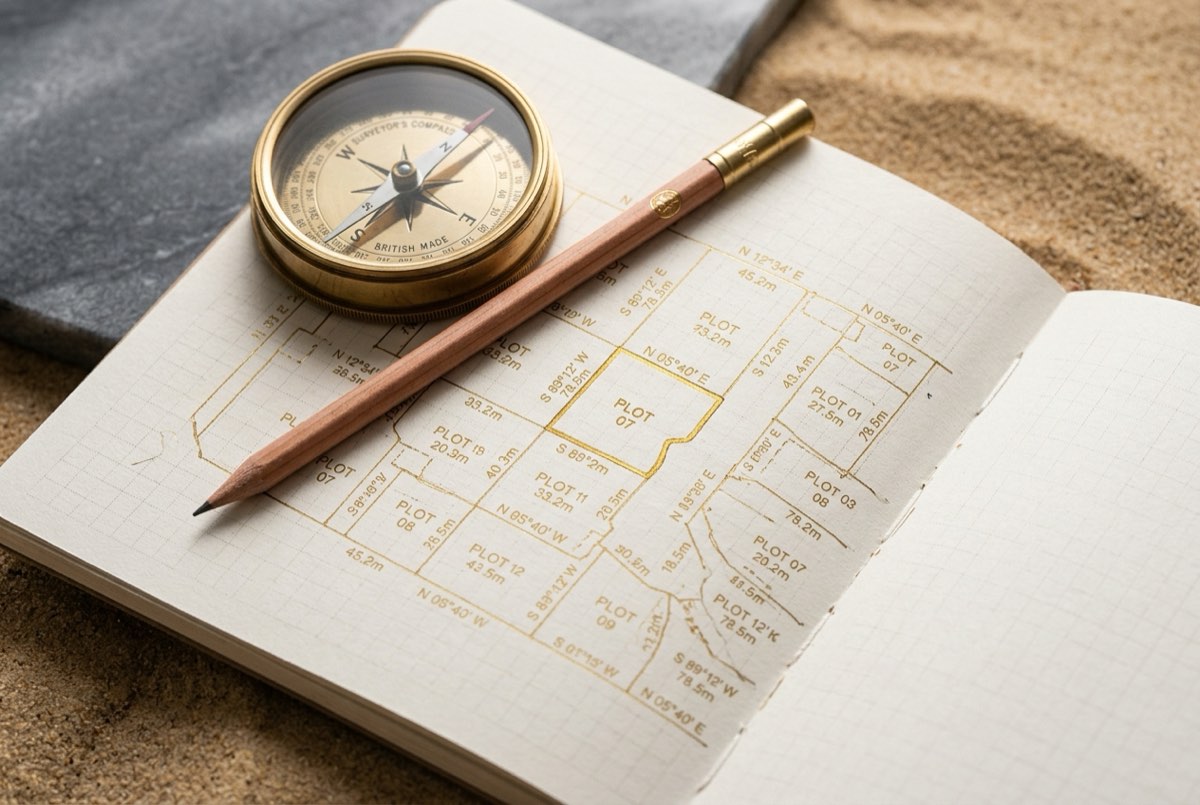
The FMB is the authoritative survey map of a plot, while the 11E is a purpose-specific sketch prepared for a particular sub-division. The FMB is the source of truth for boundaries; the 11E is a derived drawing that must be consistent with it.
Karnataka's survey records form a layered system, each with a different job:
| Record | What it contains | Role in diligence |
|---|---|---|
| Tippani (Tippan) | Original settlement-survey field book: linear measurements, angles, offsets per survey number | The historical prime reference for where boundaries were originally fixed |
| FMB (Field Measurement Book) | Plot-level measurements, boundary specifics, and sketch of the specific survey number/hissa | The definitive, plot-specific boundary and extent record |
| Akarband | Register of survey-number-wise area, assessment, and classification | Cross-check on official extent and land classification for revenue purposes |
| Atlas (village map) | The village-level map showing all survey numbers and their relative positions | Confirms the parcel's location and neighbours; spots overlaps |
| 11E sketch | Boundary of a sub-divided portion, prepared for registration | The registrable demarcation of the portion you are buying |
For a land acquirer, the FMB and the 11E together answer the spatial question — is the land on the ground actually the land in the deed? The RTC and Kaveri answer the ownership and encumbrance questions. A complete Title Search Report needs both.
When exactly do you need an 11E sketch?
You need an 11E sketch any time the transaction touches part of a survey number rather than the whole. The most common triggers are below.
- Partial sale of agricultural land. Selling 1 acre out of a 5-acre survey number — the registrar requires the 11E for the demarcated portion.
- Gift or settlement of a portion. Transferring part of a survey number to a family member.
- Partition among co-owners. Splitting a jointly held survey number into individual shares — each resulting portion needs its boundary fixed.
- Carving out a layout or project parcel. A developer acquiring a defined block out of a larger holding — a step worth mapping into the developer's due diligence checklist before funds move.
- Resolving an extent discrepancy before sale. If the FMB-surveyed extent differs from the RTC or the deed, parties often re-survey and obtain a fresh sketch.
You generally do not need a new 11E when buying an entire, already-distinct survey number or an already-sub-divided hissa that has its own survey number and RTC. In that case, pull the existing FMB and Phodi sketch to verify the boundary — do not assume the file is complete.
Tatkal Phodi and applying on Mojini
Karnataka's Mojini portal (run under the Survey, Settlement and Land Records department) is where you apply for and download 11E, Phodi, and alienation sketches and track application status online. The standard sub-division process can be slow; the Tatkal Phodi scheme is a fast-track paid option for citizens who need the sub-division and sketch completed in a shorter window. Fees are paid online and vary by service and extent — budget for the portal charge plus the licensed surveyor's fee, and confirm the current schedule on Mojini, as it is revised periodically.
How do 11E and FMB mismatches reveal title and boundary problems?
A mismatch between the 11E sketch or FMB and the sale deed is one of the clearest spatial red flags in Karnataka diligence — it usually means the boundary, the extent, or the sub-division itself is contested. Here is what to watch for.
- Extent mismatch. The 11E/FMB shows a different area than the deed or RTC Column 2. A deed reciting "1 acre" against an 11E showing materially less means you may be paying for land that does not exist on the survey record.
- Boundary overlap with an adjacent hissa. The 11E boundary encroaches on a neighbouring survey number — a classic source of litigation between adjoining owners.
- No 11E for a portion already "sold." A prior partial sale was registered without a proper sketch, or the sub-division was never completed, leaving the chain of title spatially unclear.
- Phodi not reflected in Bhoomi. The 11E exists but the sub-division mutation never reached the RTC, so the hissa you are buying does not yet have its own clean record of rights.
- Kallu (boundary stones) not matching the sketch. Where the surveyor's planted stones on the ground differ from the FMB, expect a possession or encroachment dispute.
These spatial defects sit alongside the documentary ones — see 7 common title defects in Indian real estate for how boundary and extent problems combine with ownership and encumbrance issues to derail a deal.
What an 11E sketch and FMB cannot tell you
An 11E sketch and FMB are powerful, but they have firm limits — relying on them alone is a mistake.
- They do not prove ownership. A sketch shows where a boundary runs, not who holds title. You still need the RTC and Bhoomi records and the Kaveri encumbrance and deed history.
- They do not show encumbrances or charges. Mortgages (registered on Kaveri or filed with CERSAI) and court attachments never appear on a survey sketch.
- They do not confirm conversion or zoning. Whether agricultural land is legally usable for non-agricultural development depends on a DC conversion order and zoning — not the FMB.
- They can be stale or contested. Old FMB measurements may predate ground changes; a re-survey or Durasti (record-rectification) may be pending, which means the "authoritative" map is itself under correction.
- A sketch is not a guarantee against fraud. Like any document, an 11E can be fabricated or issued on incorrect inputs — which is why a lawyer reviews the survey trail against the deed and the RTC before signing off.
Frequently asked questions
Do I need an 11E sketch to buy a whole survey number?
Usually no. The 11E sketch is required when you are registering the sale of a portion of a survey number. If you are buying an entire, distinct survey number or an already-sub-divided hissa that has its own survey number and RTC, you do not need a fresh 11E — but you should still obtain the existing FMB and Phodi sketch to confirm the boundary and extent match the deed and the RTC.
What is the difference between an 11E sketch and a Phodi sketch?
The 11E sketch is a pre-mutation drawing showing the boundary of the portion being carved out, and it is what allows a partial sale to be registered. The Phodi sketch is generated after the sub-division mutation is completed in Bhoomi, once the portion has become its own sub-survey number. In short: the 11E enables registration; the Phodi sketch reflects the finished sub-division.
Where do I get an 11E sketch or FMB in Karnataka?
You apply for and download 11E, Phodi, and alienation sketches through Karnataka's Mojini survey portal, run under the Survey, Settlement and Land Records department. A licensed surveyor measures the portion against the existing FMB and Tippani before the sketch is issued. Application status can be tracked online. Fees are paid through the portal and vary by service.
What is Tatkal Phodi?
Tatkal Phodi is the fast-track, paid version of the sub-division (Phodi) process in Karnataka. Where the standard process can take a long time, Tatkal lets an applicant pay an additional fee online to have the sub-division and associated sketch completed in a shorter window. Confirm the current fee and timelines on Mojini, as they are revised from time to time.
What does it mean if the 11E or FMB extent does not match my sale deed?
It is a red flag for a boundary or extent dispute. It may mean the deed overstates the area, the boundary overlaps a neighbouring parcel, or the sub-division was never properly completed. Any such mismatch should be reconciled — typically by a fresh survey and cross-checking against the RTC Column 2 area and the village map — before you commit funds. A diligence team treats this as a blocking issue until resolved.
Is an 11E sketch enough to confirm clear title?
No. An 11E sketch only confirms where a boundary runs for a sub-divided portion. It says nothing about ownership, encumbrances, conversion status, or litigation. A clear-title opinion needs the survey records read together with the RTC, the Kaveri encumbrance certificate, CERSAI and court searches — and a lawyer to review and sign the final report.
Continue reading
How to Read a Bhoomi RTC (Pahani): All 13 Columns and the Column 11 Red Flags
11 min read
How to Do Due Diligence Before Buying Agricultural Land in Karnataka (Vamshavruksha + Conversion)
12 min read

How to Get a Certified Copy of a Registered Sale Deed Online from Kaveri
11 min read

Bhoomi RTC for Karnataka Land Acquisition: A Developer's Guide
11 min read
Automate your due diligence
Skip the manual portal work.
Deedwise automates everything in this article — across every connected portal — and delivers a complete Title Search Report in hours.
Request Access