TL;DR
- For non-agricultural property inside gram panchayat limits in Karnataka, Form 9 (the property register extract, often called the panchayat A-Khata) and Form 11 (the tax demand register) from eswathu.karnataka.gov.in are the records that evidence ownership and tax status — but a Form 9 is only valid if it was generated by the e-Swathu system itself, digitally signed by the Panchayat Development Officer (PDO) and verifiable by certificate number and 2D barcode.
- A manually typed, photocopied, or "out-of-system" Form 9 is not a valid title document. If it does not verify on the e-Swathu portal, treat it as a forgery until proven otherwise.
- A Form 9 issued without DC conversion and layout / Town and Country Planning approval is a classic peri-urban red flag — it means a panchayat has put a non-agricultural-looking record on land that may still legally be agricultural.
- Form 11 comes in two flavours: Form 11A (full legal approval, conversion and planning sanction done) and Form 11B (interim, often unconverted or unapproved). 11B is a yellow-to-red flag for buyers and lenders.
- e-Swathu sits alongside Bhoomi (agricultural RTC) and Kaveri 2.0 (registered deeds and encumbrance). You verify gram panchayat property by reading all three together, then having a lawyer sign off.
How do I verify gram panchayat property in Karnataka using e-Swathu Form 9 and Form 11?
You verify it by pulling the property's Form 9 and Form 11 from the official e-Swathu portal yourself (not relying on the seller's PDF), confirming the document verifies on the portal's "Verify Documents" tool, and then cross-checking the ownership, extent, and conversion status against the registered deed (Kaveri) and the source survey number (Bhoomi). e-Swathu — literally "e-property" in Kannada — is the Rural Development and Panchayat Raj (RDPR) department's digital register for non-agricultural properties that fall inside gram panchayat boundaries, outside city corporation and municipal limits.
This matters because the moment you step outside city limits in Karnataka, the Khata system changes. Inside BBMP you deal with e-Khata on e-Aasthi; inside a gram panchayat, the equivalent ownership-and-tax record is Form 9 plus Form 11 on e-Swathu. Developers and land acquirers buying peri-urban plots — exactly the land that is converting from village to town — live and die by these two forms.
What is Form 9 and what is Form 11?
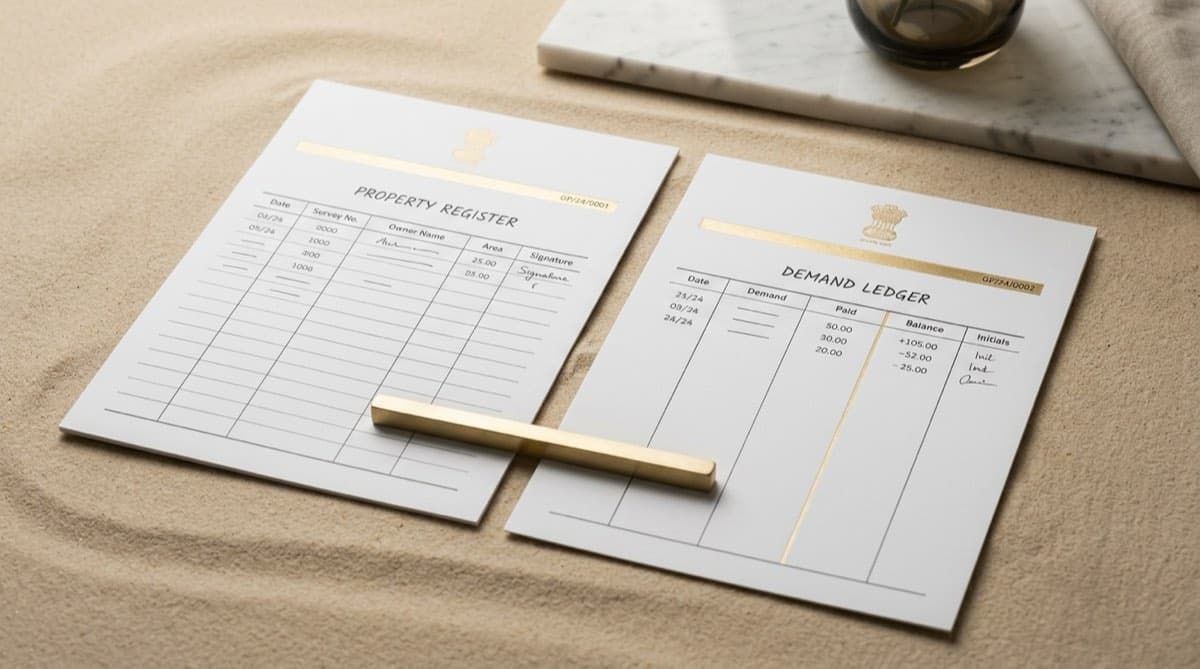
Form 9 is the property register extract for a non-agricultural property in a gram panchayat; Form 11 is the tax record for the same property. They are issued by the gram panchayat under the Karnataka Panchayat Raj (Grama Panchayat Budgeting and Accounting) Rules, 2006 (as amended).
| Record | What it is | What it tells you | Common name |
|---|---|---|---|
| Form 9 | Property register extract for a non-agricultural property under the gram panchayat | Owner name, property number, extent, location, classification as non-agricultural | Panchayat A-Khata / property register |
| Form 11 | Register of Demand, Collection and Balance (DCB) for land and buildings | Property-tax demand and payment status for the property | Tax register / DCB extract |
| Form 11A | The tax record where conversion and planning approvals are in place | A more reassuring signal of a fully regularised property | "Clean" 11 |
| Form 11B | Interim tax record, often for property not fully converted or approved | A warning that legal conversion or layout sanction may be missing | Interim / provisional 11 |
Form 9 answers "who owns this and is it recorded as non-agricultural?" Form 11 answers "is it on the tax rolls and are taxes paid?" Neither, on its own, is title — they are panchayat records, not a conveyance. The actual transfer of ownership still happens through a registered sale deed.
Step-by-step: how to pull and verify Form 9 and Form 11 on e-Swathu
Follow these steps on eswathu.karnataka.gov.in. The portal is in Kannada and English; the exact menu labels shift between portal versions, but the flow is stable.
- Open the portal at eswathu.karnataka.gov.in and choose the "Search your property" / "Get Form 9 and 11" path.
- Drill down the geography: District, Taluk, Gram Panchayat, then Village. This mirrors the revenue hierarchy, so have the village name ready.
- Identify the property: select by owner name or property ID (the unique number printed on any existing Form 9). Pull up the record.
- Download Form 9 and Form 11 for that property directly from the portal. A portal-generated copy is the one that matters — not a copy the seller hands you.
- Verify the document: use the "Verify Documents" / "Verify your document" tool on the portal and enter the certificate number (pramaana patra number) printed on the form. A genuine document resolves to a record; a fake does not.
- Check the digital signature and barcode: every genuine e-Swathu Form 9 and Form 11 is digitally signed by the Panchayat Development Officer (PDO) and carries a unique certificate number plus a 2D barcode encoding that signature. Scan the barcode with a reader; it should match the document.
What a genuine Form 9 / Form 11 looks like
A valid e-Swathu document is machine-generated and has a consistent fingerprint. Use it as a checklist:
- A unique certificate / document number that verifies on the portal.
- A 2D barcode that, when scanned, carries the PDO's digital signature.
- A PDO digital signature — there is no ink signature on a genuine e-Swathu form, and the absence of a wet signature is normal, not suspicious.
- The property classified as non-agricultural with a clear property number, owner name, and extent.
- Geography (district / taluk / GP / village) that matches the survey number it was carved from.
If a "Form 9" is hand-typed, rubber-stamped, photocopied with no barcode, or fails portal verification, it is not a record you can rely on — and in Karnataka, manually issued Form 9/11 outside the system has historically been a vector for fraud, which is exactly why the state moved everything onto e-Swathu.

What does Form 9 actually prove — and what can it not tell you?
Form 9 proves a gram panchayat has entered a property in its non-agricultural register and is taxing it. It does not prove clean, marketable title, and it cannot, by itself, confirm that the land was lawfully converted. This is the single most important limitation for buyers to internalise.
For a property to genuinely qualify for Form 9, the land must have been legally converted from agricultural to non-agricultural use (DC conversion under the land revenue framework) and carry the necessary sanctions from the Town and Country Planning / layout authority. In practice, panchayats have sometimes issued Form 9 on land that never cleared those steps. So a Form 9 is necessary but not sufficient.
Form 9 / Form 11 cannot tell you:
- Whether DC conversion actually happened. Form 9 may exist without a valid conversion order. You must separately verify the DC conversion order and confirm it is genuine, not a fabricated PDF.
- Whether the layout / sub-division was approved. A Form 9 on a plot inside an unapproved (revenue) layout does not legalise the layout. The plot can still be unauthorised.
- The chain of title. Form 9 shows the current recorded owner, not the 30-year history of how ownership moved. That lives in registered deeds on Kaveri.
- Encumbrances and mortgages. A subsisting mortgage or charge will not appear on Form 9. You need the encumbrance certificate from Kaveri 2.0 and a CERSAI check.
- Litigation or disputed ownership. Panchayat records are not a court docket; pending suits, injunctions, or tenancy claims are invisible here.
- The original agricultural lineage. Where the parcel came from agricultural land, the Bhoomi RTC (Pahani) and its Column 11 are where you trace the journey from farm to plot.
In other words, Form 9/11 are one pillar of a Land check, not the whole Title Search Report. Treat them as the panchayat's entry, then go verify the legal substance behind that entry.
What are the red flags in a gram panchayat (e-Swathu) property?
The headline red flag is a Form 9 with no matching DC conversion or layout approval — a panchayat record dressed up to look like clean non-agricultural title on land that is still legally agricultural. Here are the patterns a diligence team specifically hunts for in peri-urban land.
Conversion and approval gaps
- Form 9 but no conversion order. The land is recorded as non-agricultural in the panchayat, but no valid DC conversion order exists. This is the most common peri-urban trap. Cross-check against the conversion order and the Bhoomi RTC.
- Form 11B instead of 11A. An 11B record is an interim/provisional tax entry typically used where conversion or planning approval is incomplete. Lenders often will not fund 11B property cleanly, and resale value suffers. Treat 11B as "explain before you buy."
- Revenue-layout plots. A Form 9 on a plot inside an unapproved layout (no sanction from the planning authority) does not regularise it. The plot may face demolition or be unbankable.
Document-authenticity gaps
- Manual / out-of-system Form 9. Any Form 9 that is not portal-generated, has no certificate number, or fails the "Verify Documents" check. Historically a forgery vector.
- Barcode or signature mismatch. A document whose 2D barcode will not scan, or whose PDO digital signature does not verify on the portal.
- Details that do not match across portals. Owner name, extent, or property identity on Form 9 that conflicts with the registered deed (Kaveri) or the source survey number (Bhoomi).
Source-of-land gaps
- Granted-land / restricted-tenure origins. If the parcel traces back to government-granted land to a Scheduled Caste/Scheduled Tribe holder, the Karnataka PTCL Act, 1978 can restrict or void transfers — a Form 9 does not cure a PTCL defect.
- Agricultural-tenure baggage. Even after the relaxation of the old 79A/79B restrictions, the original tenure and land-reform history still matter, and they flow through into how a parcel can be held and transferred today.
Each of these maps to a broader category of title defect in Indian real estate — they just wear gram-panchayat clothing.
How does e-Swathu fit with Bhoomi, Kaveri, and the rest of a Karnataka title search?
e-Swathu is the non-agricultural, gram-panchayat layer; Bhoomi is the agricultural Record of Rights layer; Kaveri 2.0 is the registered-deed and encumbrance layer. A real verification reads them together, because peri-urban land usually has a foot in all three.
| Portal | Covers | The record you pull | What it confirms |
|---|---|---|---|
| e-Swathu | Non-agricultural property in gram panchayat limits | Form 9, Form 11 (11A/11B) | Panchayat ownership entry + tax status |
| Bhoomi | Agricultural land, statewide | RTC / Pahani (and Column 11) | Cultivator/owner, extent, source survey number, mutations |
| Kaveri 2.0 | Registered instruments + encumbrance | Sale deed, Encumbrance Certificate | The actual conveyance and any registered charges |
| e-Aasthi (BBMP) | Property inside BBMP limits | e-Khata | Urban Khata (the city equivalent of Form 9) |
A clean peri-urban file generally shows: a source survey number on Bhoomi, a valid DC conversion order moving it to non-agricultural, a registered sale deed on Kaveri with a clear encumbrance certificate, and then a portal-verified Form 9 / Form 11A on e-Swathu reflecting the current owner. If any link is missing or contradicts another, that is where the risk lives.
Encouragingly, recent reforms are tightening these links. Under Karnataka's broader e-Swathu modernisation, conversion orders are increasingly expected to trigger an e-Swathu workflow to the relevant panchayat to initiate Form 9, and e-Swathu is being wired to talk to Kaveri and Bhoomi so that records stay in sync. That reduces — but does not eliminate — the gap between "panchayat says non-agricultural" and "legally non-agricultural." You still verify each pillar.
Where Deedwise fits
Deedwise pulls e-Swathu Form 9 / Form 11 alongside Bhoomi RTC, the Kaveri encumbrance and deed sweep, K-GIS spatial data, and litigation searches, translates the Kannada records, flags exactly the gaps above (no conversion behind a Form 9, 11B status, manual/unverifiable documents, PTCL-origin land), and assembles the 4-pillar report. The AI gathers and drafts; a lawyer reviews and signs. e-Swathu is a powerful source, but it is one input into a legal opinion — not the opinion itself. For the full set of checks, see the developer's property due diligence checklist.
Frequently asked questions
Is Form 9 the same as a Khata? Functionally, yes — Form 9 is the gram panchayat's property register extract for a non-agricultural property, which is why it is commonly called the panchayat "A-Khata." But it is the rural-area equivalent. Inside BBMP you get an e-Khata on e-Aasthi instead. Importantly, neither a Form 9 nor a Khata is a title document; both are local-body records of ownership and tax, and the real transfer of ownership happens through a registered sale deed.
How do I check if a Form 9 is genuine or fake? Pull the document yourself from eswathu.karnataka.gov.in rather than trusting the seller's copy, then use the portal's "Verify Documents" tool with the certificate number printed on the form. A genuine e-Swathu Form 9 is machine-generated, digitally signed by the Panchayat Development Officer, carries a unique certificate number, and has a 2D barcode encoding that signature. A hand-typed, photocopied, or out-of-system "Form 9" with no barcode or one that fails portal verification should be treated as invalid.
What is the difference between Form 11A and Form 11B? Both are tax records (from the panchayat's Demand, Collection and Balance register). Form 11A generally indicates a property that has the necessary conversion and planning approvals in place, while Form 11B is an interim or provisional record often used where conversion or layout sanction is incomplete. For a buyer or lender, 11B is a warning sign: such properties can be harder to finance, may have lower market value, and need the missing approvals confirmed before purchase.
Can a property have a Form 9 without DC conversion? It happens, and it is a serious red flag. In principle, a property qualifies for Form 9 only after the land has been legally converted from agricultural to non-agricultural use and has the required Town and Country Planning approvals. In practice, some panchayats have issued Form 9 on land that never cleared those steps. Always verify the DC conversion order and the layout approval separately — a Form 9 does not, by itself, prove the conversion is real.
Does a Form 9 prove I have clear title? No. Form 9 proves only that the gram panchayat has entered the property in its non-agricultural register and is taxing it. It does not show the chain of title, encumbrances or mortgages, pending litigation, or restricted-tenure origins such as PTCL-granted land. Clear, marketable title is established by reading Form 9 and Form 11 together with the Bhoomi RTC, the registered deeds and encumbrance certificate on Kaveri, conversion and layout approvals, and litigation checks — and then having a lawyer review and sign off.
Why do I need e-Swathu if I already have the sale deed? The sale deed (registered on Kaveri) is the conveyance, but the gram panchayat's own records must reflect you as the owner for tax, property numbering, and many downstream approvals. A registered deed without a corresponding, portal-verified Form 9 / Form 11 in the buyer's name leaves a gap between "I bought it" and "the local body recognises me as owner." Both pieces — the deed and the panchayat record — should line up.
Continue reading
How to Read a Bhoomi RTC (Pahani): All 13 Columns and the Column 11 Red Flags
11 min read

What Is the Phodi (Podi) Process for Splitting a Survey Number in Karnataka — and the Joint-Khata Risk
10 min read
What Is DC Conversion of Agricultural Land in Karnataka (Section 95) — Cost, Process, 2026 Reforms
10 min read

Bhoomi RTC for Karnataka Land Acquisition: A Developer's Guide
11 min read
Automate your due diligence
Skip the manual portal work.
Deedwise automates everything in this article — across every connected portal — and delivers a complete Title Search Report in hours.
Request Access