TL;DR
- Run a multi-parcel pipeline by standardising one per-parcel template — chain of title, EC, RTC/mutation, encumbrance, litigation, zoning/conversion, survey — then running every portal check in parallel and ranking each parcel clear, conditional, or defective so an entire pipeline is screened in days, not months.
- The unit of work is the parcel, not the deal: each survey number gets its own mini Title Search Report, and the aggregation deal is the roll-up of those verdicts.
- Parallelism is the whole game — a single parcel is gated by the slowest portal (Kaveri can take 10–20 minutes per parcel); fifty parcels only finish fast if they run concurrently, not one after another.
- Triage before you spend: a quick first-pass screen on Bhoomi RTC and zoning kills obviously defective parcels cheaply, so deep encumbrance and litigation work is reserved for the survivors.
- This is data-gathering at scale; a lawyer still reviews the flagged parcels and signs the title opinion before any JDA, MoU, or payout.
How does a developer or aggregator run title due diligence across many parcels at once?
You run it as a pipeline, not a stack of separate jobs. Define one standardised checklist that every parcel must pass, run the portal checks for all parcels in parallel, score each parcel on a single verdict scale, and let the results tell you which parcels deserve deeper work and which to drop. The deal-level decision is then just the sum of the parcel-level verdicts.
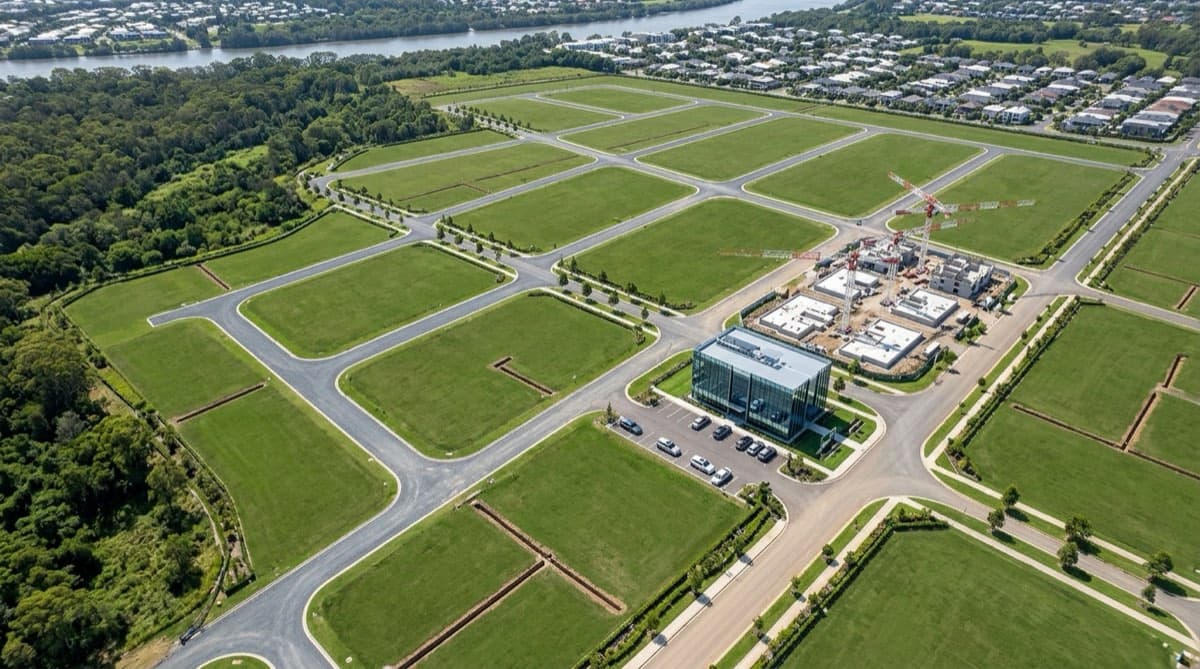
A land aggregation — assembling twenty, fifty, or a hundred adjacent survey numbers into one developable extent — fails differently from a single plot purchase. With one plot, a defect means you walk away. With a pipeline, a single defective parcel in the middle of your layout can sterilise the parcels around it (no access road, a broken boundary, a holdout owner). So the goal is not just "is each parcel clean" but "which combination of clean parcels gives me a contiguous, buildable site." That requires screening the whole set on the same yardstick, fast.
The three moves that make this work:
- Standardise the template so every parcel is judged identically and results are comparable.
- Parallelise the portal work so the pipeline finishes in the time of the slowest single parcel, not the sum of all parcels.
- Rank and triage so money and lawyer hours flow to the parcels that can actually close.
This is the same four-pillar method as a single-parcel Title Search Report — ownership, land, encumbrance, litigation — applied as a batch with a scoring layer on top.
What does a standardised per-parcel due-diligence template contain?
Every parcel runs through the identical set of checks, grouped under the four pillars, so the only thing that varies between parcels is the findings. Without a fixed template you cannot compare parcel A to parcel B, and comparability is the entire point of a pipeline.
Here is the per-parcel template, the source for each check, and what a "bad" result looks like:
| Pillar | Check | Source | Red flag |
|---|---|---|---|
| Ownership | 30-year chain of title (every transfer accounted for) | Kaveri EC + registered deeds | A gap where the parcel changed hands with no registered instrument |
| Ownership | Current owner matches last registered deed | Bhoomi RTC Col. 4 vs Kaveri | RTC owner differs from the last sale-deed buyer (mutation lag) |
| Ownership | Mutation history (dakhil kharij) | Bhoomi mutation register | A transfer with no corresponding mutation entry |
| Land | Land classification / Patta type | Bhoomi RTC Col. 3 | Government, granted, Inam, or PTCL land with transfer restrictions |
| Land | Col. 11 revenue encumbrances | Bhoomi RTC Col. 11 | A loan or charge with no release in the EC |
| Land | Conversion (agricultural to NA) and zoning | DC order + Col. 13 + K-GIS / planning-authority overlay | Pending or rejected conversion; green zone; reserved for public use |
| Land | Survey extent and boundary | Bhoomi Col. 2 + K-GIS + 11E sketch | Large area discrepancy; parcel bisected by a road or acquisition line |
| Encumbrance | Registered mortgages | Kaveri EC + full deed sweep | A mortgage deed with no release |
| Encumbrance | Equitable mortgages (deposit of title deeds) | CERSAI | A live security interest absent from the EC |
| Litigation | Civil/criminal cases by survey number and by owner name | eCourts + State High Court | An injunction, partition suit, or lis pendens (Sec. 52 TOPA) |
| Litigation | Insolvency, for company sellers | NCLT / IBBI + MCA charges | Asset under an IBC moratorium or in CIRP |
A few of these are deep enough to warrant their own treatment — Bhoomi Column 11 red flags on revenue land, and the equitable mortgages that a clean Kaveri encumbrance certificate silently misses but CERSAI catches. The template's job is to guarantee none of them is skipped on any parcel.
Why the template must be source-backed, not summary-only
Each finding has to link to the underlying record — the actual RTC, the actual EC entry, the actual case number. When you are reviewing fifty parcels, a verdict with no evidence trail is unreviewable; the lawyer cannot sign what they cannot trace back to a government record. Treat every cell in that table as "claim plus link to source," not just a colour.
How do you run the portal checks in parallel across many parcels?
The unlock is concurrency: fetch from every portal for every parcel at the same time, rather than finishing one parcel before starting the next. A single parcel's wall-clock time is set by its slowest portal — and on Karnataka's stack, that is Kaveri 2.0, which involves a CAPTCHA and a sweep of dozens of deed types and can run 10–20 minutes per parcel. Done sequentially, fifty parcels could mean days of pure waiting. Done concurrently, the batch finishes in roughly the time of one parcel plus queueing.
The practical sequencing inside a batch:
- Resolve geography once per parcel — district, taluk, hobli, village codes — so every scraper queries the right portal codes with no fuzzy matching at run time.
- Fetch boundaries and parcel geometry (K-GIS) so spatial checks and contiguity analysis have something to work with.
- Fan out the document fetch across Bhoomi, Kaveri, K-GIS, CERSAI and the municipal record (e-Aasthi / e-Swathu) for all parcels at once.
- Run litigation searches (eCourts, High Court, NCLT) against the survey numbers and the owner names extracted in step 3.
- Normalise and translate the records — Karnataka records are largely in Kannada — into structured, comparable fields.
- Build the per-parcel report and score it.
A real constraint worth naming: portals are rate-limited and some are credential-gated, so "parallel" has a ceiling. Kaveri in particular has a daily query quota. A mature pipeline processes as many parcels as the quota allows now and queues the rest for the next window — you do not get infinite concurrency, and any tool promising instant results on a hundred parcels is glossing over this. For the full picture of where the time actually goes, see how long a title search takes and what can be made faster online.
Two-pass screening saves the most money
Do not run the full deep dive on every parcel from day one. Run a cheap first pass — Bhoomi RTC classification plus zoning/conversion status — across the entire pipeline. Parcels that are government/granted land, sit in a green zone, or have an obviously broken extent are killed before you spend on the 30-year EC chain, the CERSAI search, and the litigation sweep. Then run the deep, expensive pass only on the survivors. This is the single biggest cost lever in multi-parcel diligence.
How do you rank parcels clear, conditional, or defective?
Score every parcel on one verdict scale, then tally the scale across the pipeline. A practical four-state scale that maps cleanly to a developer's next action:
| Verdict | What it means | Developer action |
|---|---|---|
| Clear | All pillars pass; no open flags | Proceed to negotiate / sign |
| Conditional | Curable defect (e.g. mutation lag, an undischarged charge with a known lender, a pending conversion) | Make the cure a condition precedent in the JDA/MoU |
| Defective | Structural defect (government/PTCL land, a broken chain, active title litigation) | Drop, or carve out of the assembly |
| Pending | A portal did not return / a record could not be fetched | Re-run; do not treat absence of data as a clean result |
That last state matters most in batch work. The dangerous failure is not a defect you found — it is a parcel whose Kaveri sweep silently failed, leaving a blank where a mortgage might be. A disciplined pipeline marks those parcels "pending," excludes them from the clear count, and retries them, rather than letting a missing record masquerade as a clean one.
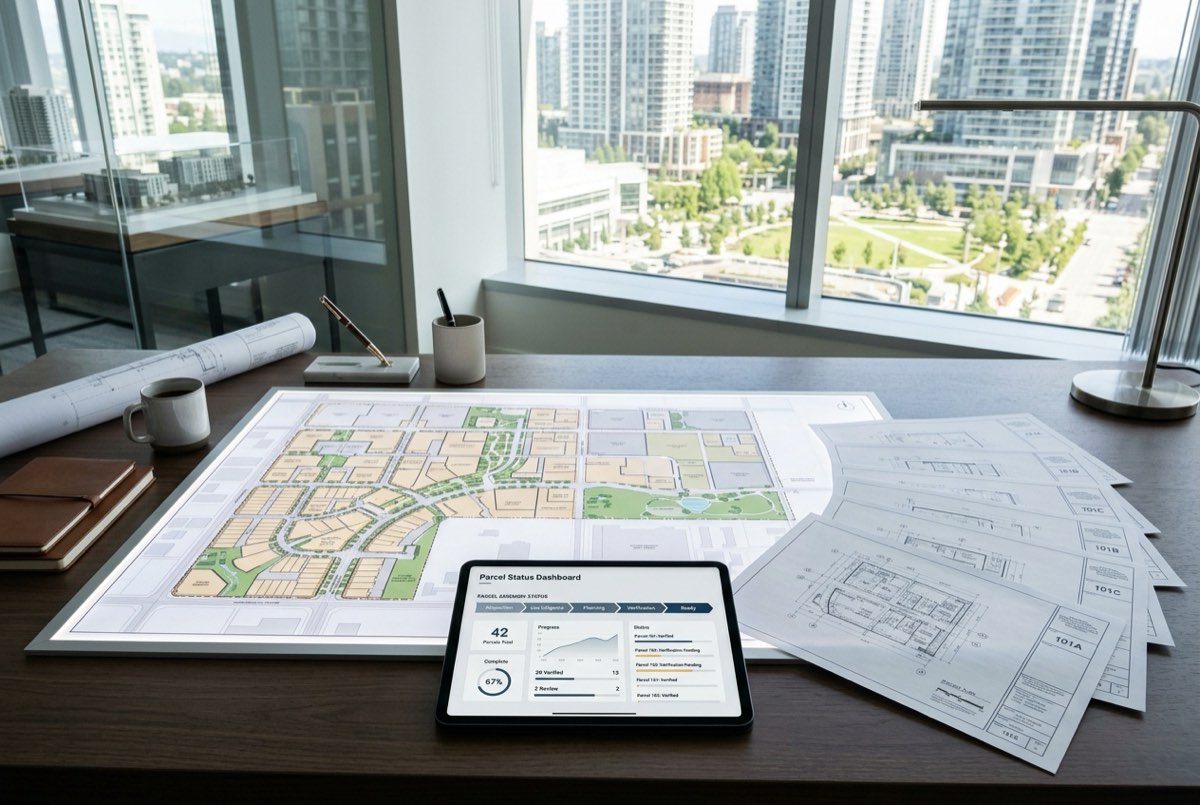
The pipeline then rolls the verdicts up: "32 clear, 9 conditional, 4 defective, 5 pending" tells the acquisition team in one line where the assembly stands and what to attack next. Overlay the verdicts on the parcel map and the conditional/defective parcels show you exactly where your contiguity breaks. From there, every conditional parcel feeds a cure list that becomes the condition-precedent schedule when you reach the agreement stage — which is precisely the diligence to complete before signing a JDA or MoU.
What can a portal-driven multi-parcel pipeline NOT tell you?
A pipeline gathers and scores recorded data extremely well; it does not exercise legal judgement, and several risks live outside the portals entirely. Be honest about the gaps:
- Possession and the physical site. Records show who owns the parcel on paper, not who is farming it, whether there are tenants, encroachments, or an access road that exists in fact. Boundaries and possession need a ground survey and a site visit.
- Unregistered and oral arrangements. Agreements to sell, family settlements, oral tenancies, and side letters never hit a portal. An EC only lists registered transactions.
- Forgery and impersonation. A portal confirms a deed was registered; it cannot confirm the person executing your sale deed is the real owner. Identity verification is human work.
- Records that lag reality. Mutation can run months behind a registration; a recently filed case or a fresh acquisition notification may not be indexed yet. A clean result is a snapshot, not a guarantee.
- The legal call itself. Whether a "conditional" defect is genuinely curable, whether a chain gap is fatal, whether a PTCL question voids the deal — that is interpretation. The pipeline flags; a lawyer decides and signs.
This is why the model is AI-gathers, lawyer-signs. The pipeline compresses weeks of multi-portal data-gathering into hours and makes fifty parcels comparable on one scale — but the title opinion that protects you in a JDA, a payout, or a financing event is still authored and signed by a qualified advocate. For where that line sits between automation and judgement, see the developer due-diligence checklist.
Frequently asked questions
How many land parcels can you realistically run title due diligence on at once?
There is no hard cap on parcels, but there is a cap on concurrency. The binding constraint is portal rate limits and credential quotas — Kaveri 2.0 in particular has a daily query limit and a slow per-parcel CAPTCHA flow. A well-built pipeline processes as many parcels as the day's quota allows and queues the remainder for the next window, so a hundred-parcel assembly is screened over a few days rather than truly all at once. Be skeptical of any service claiming instant results on large batches.
What is the difference between single-property and multi-parcel due diligence?
The checks per parcel are identical — the same four pillars (ownership, land, encumbrance, litigation). Multi-parcel adds three things on top: a standardised template so parcels are directly comparable, parallel execution so the batch finishes in the time of the slowest single parcel, and a ranking/triage layer that scores every parcel and rolls the verdicts up to a deal-level view. It also adds a contiguity question a single purchase never has: a defective parcel in the middle can sterilise the clean parcels around it.
How do you rank or compare title risk across many parcels?
Score each parcel on one verdict scale — typically clear, conditional, defective, and pending — derived from how it performed against the standardised template. "Clear" means proceed; "conditional" means a curable defect that becomes a condition precedent in the agreement; "defective" means drop or carve out; "pending" means a record could not be fetched and must be re-run, never counted as clean. Tallying the scale across the pipeline gives the acquisition team a one-line status and a prioritised cure list.
Can AI do multi-parcel land due diligence on its own?
AI can do the heavy, repetitive part — pulling records from eight-plus government portals for every parcel in parallel, translating Kannada records, extracting structured fields, flagging anomalies, and ranking parcels on a common scale. It cannot verify physical possession, detect forgery or impersonation, see unregistered side agreements, or make the legal call on whether a defect is fatal or curable. The reliable model is AI gathers and drafts; a qualified lawyer reviews the flagged parcels and signs the title opinion.
Which Karnataka portals does a multi-parcel pipeline pull from?
For Karnataka land, the core sources are Bhoomi (RTC/Pahani and mutation register), Kaveri 2.0 (encumbrance certificate and registered deeds), K-GIS / KSRSAC (boundaries and zoning overlays), CERSAI (equitable mortgages), e-Aasthi or e-Swathu (municipal/khata records), and for litigation eCourts, the Karnataka High Court e-services, and NCLT for company sellers. A pipeline queries these concurrently per parcel; the same method transfers to other states using their equivalent record portals.
Continue reading

What Title Due Diligence to Run Before Signing a JDA or MoU (Developer Guide)
10 min read

How Long Does a Title Search Take in India — and Can It Be Done Faster Online?
10 min read
What Approvals Make a Bangalore Plot Safe to Buy: BBMP vs BDA vs BMRDA vs BIAAPA
9 min read

The Developer's Property Due Diligence Checklist: 30+ Checks Before You Sign the MoU
13 min read
Automate your due diligence
Skip the manual portal work.
Deedwise automates everything in this article — across every connected portal — and delivers a complete Title Search Report in hours.
Request Access