TL;DR
- To check Haryana / Gurugram land records online, go to jamabandi.nic.in (the Web-HALRIS portal), open Jamabandi Nakal for Checking, pick district -> tehsil -> village, and search by owner name, khewat, or khasra; any ownership change since the last revision appears as a separate mutation (intkaal) entry.
- The Jamabandi is Haryana's Record of Rights (the "fard"). It bundles four ideas you must read together: khewat (the ownership account), khatauni (who cultivates/possesses), khasra (the plot number), and intkaal (the mutation that records a transfer).
- Haryana revises its Jamabandi on a roughly five-year cycle, so the copy you pull shows ownership as of the last revision plus any sanctioned mutations since — never assume it is "live to today".
- The online Nakal is reference-only: it is unsigned, it is not a title guarantee, and it does not show encumbrances, court cases, or whether the registered deed chain is clean.
- For a transaction, pair the Jamabandi with the registered deed copy (HARIS), the mutation register, and a lawyer's title opinion — exactly the multi-source approach a proper Title Search Report follows.
How do I check Jamabandi land records online in Haryana and Gurugram?
Use the state portal at jamabandi.nic.in, the public face of Web-HALRIS (Haryana Land Records Information System), built by the National Informatics Centre for the Haryana Revenue Department. It is the same portal for the whole state, so Gurugram (Gurgaon) records live there too — you just select the Gurugram district and the relevant tehsil.
The fastest path:
- Open jamabandi.nic.in and go to the Jamabandi menu, then Jamabandi Nakal for Checking.
- Choose your District -> Tehsil/Sub-Tehsil -> Village. For Gurugram urban parcels, pick the Gurgaon district and the matching tehsil (for example Gurgaon, Sohna, Pataudi, Manesar, or Wazirabad, depending on where the land sits).
- Pick how you want to search: By Owner Name, By Khewat, or By Khasra/Survey Number. Khasra is the most precise if you have it.
- Select the Jamabandi year offered for that village (this tells you which revision you are reading), and open the record.
- Read the result on screen. To keep a copy, take a screenshot or print to PDF — note that this is a viewing copy, not a certified Nakal.
If you only know the owner's name, start there to find the khewat, then re-search by khewat or khasra to isolate the exact parcel. Name searches are noisy because common names and spelling variants (and patronymics) repeat across a village.
What does the record actually look like?
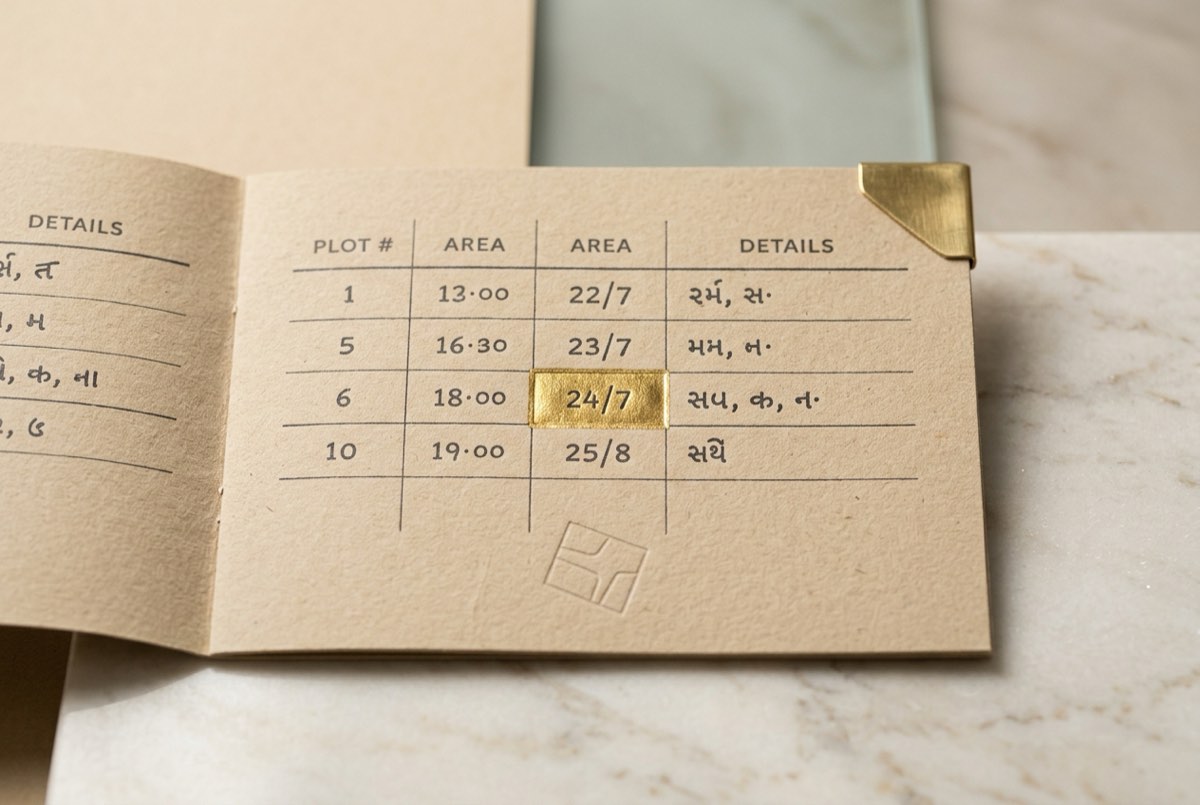
A Jamabandi is laid out in columns. You do not read any single number in isolation — you read the row across. The four terms below are where most buyers get confused.
| Term | What it is | What it tells you | Watch-out |
|---|---|---|---|
| Khewat (khata) | The ownership account for a set of co-sharers | Who owns, and in what shares | Khewat numbers can be renumbered at the next revision — they are not permanent IDs |
| Khatauni (khatauni no.) | The cultivation/possession account under a khewat | Who actually holds or tills the land | Owner and cultivator can differ; tenancy or possession notes matter |
| Khasra (killa) number | The plot number for a specific parcel | The physical piece of land | Subdivisions show as fractions (1/1, 1/2/3); the base khasra stays constant |
| Intkaal (mutation) | The entry recording a change of ownership/rights | The transfer event itself, with an Intkaal/Rapat number | A pending or rejected intkaal means ownership has not legally moved on the record |
So the mental model is: khewat = the account, khatauni = the possession, khasra = the plot, intkaal = the change. A clean parcel reads consistently across all four.
How do I see ownership changes (mutation / intkaal) in Haryana?
Ownership changes appear as mutation (intkaal) entries, not as edits to the old Jamabandi. On jamabandi.nic.in, use Mutation -> Check Mutation Status / Mutation Nakal, select district-tehsil-village, and look up the entry by the Intkaal (Rapat) number or by owner.
This matters because of how Haryana maintains the record. The Jamabandi itself is revised on a roughly five-year cycle — a Patwari prepares the fresh Jamabandi and a Revenue Officer attests it. Between those revisions, the record does not silently update. Every sale, inheritance, partition, gift, or court-ordered change is logged as a separate intkaal, which rides on top of the last revision.
The practical consequence for a buyer or lender: the Jamabandi you download shows ownership as of the last revision, plus whatever mutations have been sanctioned since. To know who owns the land today, you must check both the latest Jamabandi and the mutation register for any newer intkaals — especially ones that are still pending or rejected, because until a mutation is sanctioned the ownership has not moved on the revenue record. A registered sale deed and a mutation are two different steps; registration alone does not update the Jamabandi.
Registered deed vs. revenue record
Haryana deeds are registered in the HARIS system at the Sub-Registrar's office; the registered, stamped document is what creates/transfers the interest, and it later feeds the mutation that updates the Jamabandi. The Jamabandi is a revenue record (for land revenue and possession), not a conclusive title document. A complete check reads the deed chain and the revenue chain together — the same principle that governs a Title Search Report anywhere in India.
What can the online Jamabandi NOT tell you?
This is where most online checks quietly fail. The portal is excellent for who the record says owns the land — and silent on almost everything else. An online Jamabandi cannot, by itself, tell you:
- Encumbrances and mortgages. The Jamabandi is not an encumbrance certificate. Bank charges and registered mortgages are not reliably reflected here; you need the deed/registration trail and a CERSAI search to surface secured lending.
- Litigation. Pending suits, stays, partition disputes, or injunctions do not appear in a Nakal. A separate search of civil courts and revenue courts is required.
- A guaranteed, marketable title. India follows presumptive title, not conclusive title (the Transfer of Property Act 1882 and Registration Act 1908 govern transfer and registration; the Limitation Act 1963 governs adverse-possession and timing risk). The record can be wrong, stale, or based on a defective earlier deed.
- Authenticity / legal weight of the online copy. The viewing copy is reference-only and unsigned; for legal use you typically need a certified Nakal. Always reconcile the on-screen data against the certified document.
- Conversion, zoning and master-plan status. Whether agricultural land is licensed/CLU-approved for development, or how it sits under the Gurugram-Manesar master plan, is a separate inquiry from the revenue record.
Because of these gaps, treat the Jamabandi as one input, not the verdict. The common title defects in Indian real estate — forged links in the chain, undisclosed co-owners, fraudulent or duplicate sales, pending mutations — are precisely the things a single record will not flag on its own.
What does Haryana's Jamabandi correspond to in other states?
If you have done diligence in another state, the concept transfers even though the names change. Every Indian state keeps a Record of Rights plus a registration/encumbrance system; only the portal and the local vocabulary differ.
| State | Record of Rights / parcel record | Portal | Rough Haryana equivalent |
|---|---|---|---|
| Haryana | Jamabandi (fard); khewat / khatauni / khasra | jamabandi.nic.in (Web-HALRIS) | — |
| Karnataka | RTC / Pahani | Bhoomi; Kaveri 2.0 for deeds/EC | Jamabandi + registry |
| Maharashtra | 7/12 (Satbara), 8A | Mahabhulekh / Bhulekh | Jamabandi + khatauni |
| Telangana | ROR / Dharani record | Dharani / Bhu Bharathi | Jamabandi |
| Tamil Nadu | Patta / Chitta | TNREGINET (EC), e-services | Jamabandi + registry |
| Andhra Pradesh | Adangal / 1B | Meebhoomi | Jamabandi |
Useful cross-state reading: the Maharashtra 7/12 (Satbara) and Telangana Dharani / Bhu Bharathi guides are the closest analogues to Jamabandi — each shows the same "revenue record plus registration record" split. India is also rolling out ULPIN (Bhu-Aadhaar), a 14-digit parcel ID meant to unify records across states — see what ULPIN / Bhu-Aadhaar means for diligence.
How should I use the Jamabandi in a real transaction?
Pull it early, but verify it against independent records before you rely on it. A sensible Gurugram/Haryana sequence:
- Identify the parcel precisely by khasra (and khewat) on jamabandi.nic.in.
- Read the chain, not a snapshot — the latest Jamabandi plus every intkaal since the last revision.
- Get the certified Nakal and the registered deed copy (HARIS) for the parcels in question.
- Run encumbrance and litigation checks separately (registration trail, CERSAI, civil/revenue courts).
- Have a lawyer issue a title opinion that reconciles all of the above.
That five-step shape is the heart of any serious land check; our developer's property due-diligence checklist breaks it down pillar by pillar (Ownership, Land, Encumbrance, Litigation).
How this maps to Deedwise: Deedwise automates the gather-and-draft layer — it pulls government land records, translates regional-language entries, normalises the data, and flags likely red flags across all four pillars. It does not replace your lawyer. A qualified professional still reviews the evidence and signs the final Title Search Report. AI does the legwork; a human owns the legal conclusion.
Frequently asked questions
What is the official website to check Jamabandi land records in Haryana? The official portal is jamabandi.nic.in, the public interface of Web-HALRIS, run by the National Informatics Centre for the Haryana Revenue and Disaster Management Department. It covers the entire state, including Gurugram (Gurgaon). Use the Jamabandi -> Jamabandi Nakal for Checking option, select district-tehsil-village, and search by owner name, khewat, or khasra.
What is the difference between khewat, khatauni and khasra? Khewat is the ownership account that groups co-sharers and shows their shares. Khatauni is the cultivation/possession account sitting under a khewat — it tells you who actually holds or tills the land, which can differ from the owner. Khasra is the plot number for a specific parcel of land; subdivisions appear as fractions. You read all three across a single row, never in isolation.
What is intkaal (mutation) in Haryana land records? Intkaal is the Haryana term for a mutation — the entry that records a change of ownership or rights due to sale, inheritance, partition, gift, or a court order. Each one carries an Intkaal/Rapat number. Because the Jamabandi itself is revised only periodically, intkaals are how ownership changes appear between revisions. A mutation that is still pending or rejected means ownership has not yet moved on the record.
Is the online Jamabandi Nakal legally valid? The copy you view online is reference-only and unsigned. It is useful for verification and a starting point for diligence, but for legal or transactional use you typically need a certified Nakal from the revenue authority, and you should reconcile it against the registered deed. The online record also does not, by itself, prove a clear or marketable title.
How current is the Jamabandi I download — is it live to today? No. Haryana revises the Jamabandi on a roughly five-year cycle (a Patwari prepares it and a Revenue Officer attests it). The version you pull reflects ownership as of the last revision, plus any sanctioned mutations since. To know the position today, check both the latest Jamabandi and the mutation register for newer or pending intkaals.
Does the Jamabandi show mortgages or court cases on the land? Generally no. The Jamabandi is a revenue record of ownership, possession and land revenue — it is not an encumbrance certificate and it does not list litigation. To surface bank charges and registered mortgages, check the registration trail and run a CERSAI search; for disputes, search the relevant civil and revenue courts separately. These are distinct, essential steps in a full Title Search Report.
Continue reading
How to Download a 7/12 (Satbara) Extract Online in Maharashtra — and 8A vs Property Card
8 min read

What Is Bhu-Naksha and How to View a Cadastral / Plot Map by Survey Number
10 min read
How to Check 7/12, 8A and Mutation Records on AnyROR Gujarat (VF-6/7/8A)
8 min read

Bhoomi RTC for Karnataka Land Acquisition: A Developer's Guide
11 min read
Automate your due diligence
Skip the manual portal work.
Deedwise automates everything in this article — across every connected portal — and delivers a complete Title Search Report in hours.
Request Access