TL;DR
- On the official UP Bhulekh portal (upbhulekh.gov.in) you can view the Khatauni (record of rights — who holds the land and on what tenure) and the Khasra/Gata (the numbered plot) for free, but the online copy is reference-only; a legally usable certified copy comes from the tehsil.
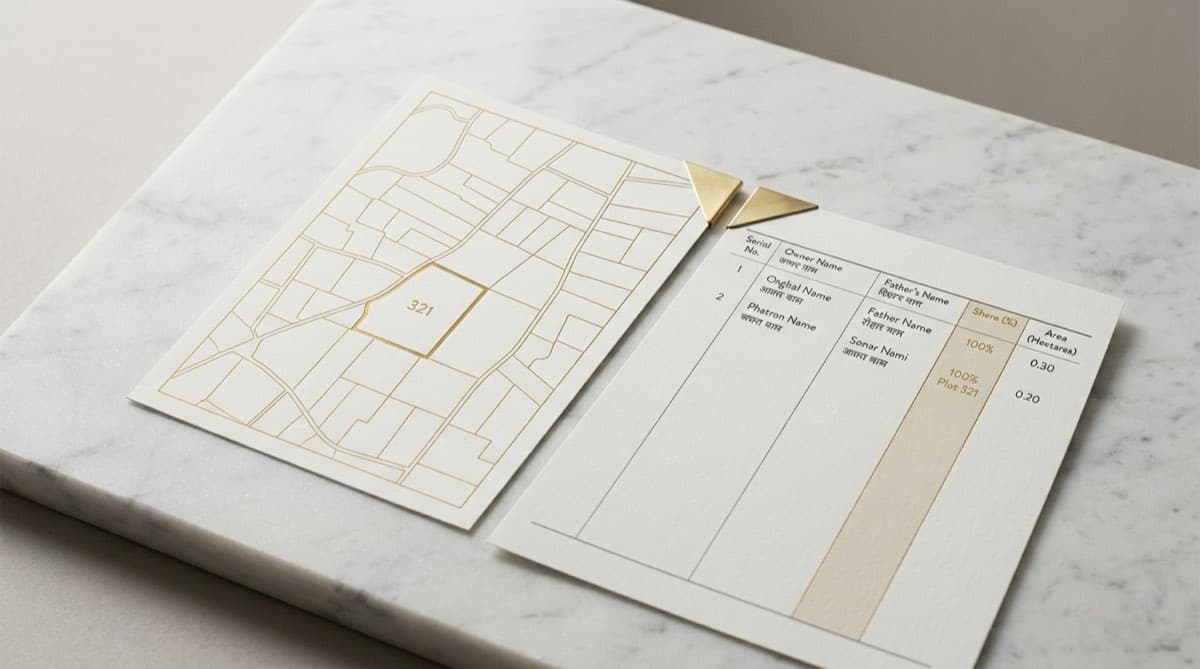
- Khatauni vs Khasra is the core distinction: a Khasra/Gata number identifies a plot of land, while the Khatauni is the account that lists every plot held by a tenure-holder, the area, and the nature of rights.
- Dakhil kharij (mutation) is the process that updates the revenue record after a sale, gift, or inheritance — it changes who appears in the Khatauni, but mutation is not title; it is fiscal record-keeping, not proof of ownership.
- Land maps live on a separate portal, Bhu-Naksha (upbhunaksha.gov.in), which shows plot boundaries against the Khasra map.
- Online records are a starting point, not a clearance: they will not show unregistered claims, court stays, family disputes, or whether a mutation was wrongly recorded. For a transaction you still need a documented chain of title that a lawyer reviews and signs.
How do I check Khasra and Khatauni land records on UP Bhulekh?
Go to the official Uttar Pradesh land records portal, upbhulekh.gov.in, run by the Board of Revenue, and choose the record you want — the Khatauni (record of rights) or a Khasra-level view. The view is free and needs no login; you only solve a CAPTCHA. What you get on screen is an information copy, not a certified document.
The portal is in Hindi, so the option labels matter. Here is the typical flow for the Khatauni:
| Step | What you do | Hindi label you are looking for |
|---|---|---|
| 1 | Open the official portal | upbhulekh.gov.in |
| 2 | Click the real-time Khatauni / record-of-rights option | "खतौनी (अधिकार अभिलेख) की नकल देखें" |
| 3 | Select your district, then tehsil, then village | जनपद / तहसील / ग्राम |
| 4 | Choose a search method | by Khasra/Gata number, by Khata (account) number, or by khatedar (holder) name |
| 5 | Enter the value and solve the CAPTCHA | — |
| 6 | View the Khatauni on screen | shows holders, account, area, plot list |
To pull the plot itself, search by Khasra/Gata number in the same flow. To find the right village code first, the homepage also has a "know the revenue-village Khatauni code" option ("राजस्व ग्राम खतौनी का कोड जानें"), since spellings of village names vary.
For boundaries and shape, UP keeps maps on a separate portal, upbhunaksha.gov.in (Bhu-Naksha). There you pick the same district/tehsil/village, click a Khasra/Gata number on the map, and see that plot's outline against its neighbours. The Bhulekh text record and the Bhu-Naksha map are two different systems — read them together.
If you have used other states' systems, this will feel familiar: UP's Khatauni plays the role that the 7/12 (Satbara) extract plays in Maharashtra, the Adangal and 1B play in Andhra Pradesh, and that Patta and Chitta play in Tamil Nadu. The portal differs; the concept of a state-maintained record of rights is pan-India.
What is the difference between Khatauni and Khasra?
In one line: a Khasra (or Gata) number is a plot of land; a Khatauni is an account that lists all the plots a person or family holds, with the area and the nature of their rights. Confusing the two is the most common mistake buyers make.
- Khasra / Gata number — the unique number assigned to a specific parcel in a village's revenue map. It is a location identifier. The matching map record (historically the Khasra register) records the plot's area, soil/land classification, and crop or use entries.
- Khatauni — the record of rights (RoR) for a Khata (account). One Khatauni can list many Khasra numbers. It shows the khatedar(s) — the recorded holders — their share, the total area, and the tenure/category under which they hold (for example, bhumidhar with transferable rights, bhumidhar with non-transferable rights, or government/Gram Sabha land). It may also carry remarks about loans, restrictions, or pending entries.
You will sometimes also hear Khewat — in north-Indian usage this is closely related to the ownership/holding account and overlaps with the Khatauni concept. For diligence, the practical pairing you need is simple: identify the Khasra/Gata of the land in question, then read the Khatauni that contains it to see who holds it and how.
Why the tenure category matters
The Khatauni does more than name a holder — it tells you what kind of holder they are. A bhumidhar with transferable rights can ordinarily sell. Land marked as non-transferable, or as Gram Sabha / government land, or land tied to ceiling and abadi (settlement) categories, carries restrictions on sale. Reading the category is the single most useful thing the Khatauni does for a buyer, because it can rule a transaction out before you spend a rupee on it. This is the broader pattern behind common title defects in Indian real estate.
What is dakhil kharij (mutation) and does it prove ownership?
Dakhil kharij is mutation: the revenue process that updates the Khatauni to reflect a change in who holds the land — after a registered sale, a gift, a partition, or inheritance (varasat). It is essential record-keeping. But it is critical to understand its limit: mutation does not confer or prove title.
This is a settled principle across Indian land law. Mutation is a fiscal act — it tells the revenue department whom to record (and, historically, whom to assess for land revenue). Ownership flows from a valid, registered transfer document under the Transfer of Property Act, 1882 and the Registration Act, 1908, and from a clean chain behind it — not from the fact that someone's name appears in the Khatauni. A person can be mutated in error; a person with a perfectly valid registered sale deed may not yet be mutated. Both situations are common.
So mutation matters for two opposite reasons:
- You need it done after you buy, so the record reflects you and revenue/levies and future dealings are clean.
- You cannot rely on it as proof that the seller actually owns what they are selling.
How mutation typically works in UP
The broad flow (apply through the UP Bhulekh / e-District route or at the tehsil), with timelines varying by district and complexity:
| Stage | What happens |
|---|---|
| Trigger | A registered deed (sale/gift), a partition, or a death (for inheritance) |
| Application | Apply with the registered deed, the prior Khatauni, and identity proofs |
| Notice | The revenue authority issues notice / invites objections from interested parties |
| Decision | If unopposed, the entry is ordered; if disputed, it goes into a contested mutation proceeding |
| Update | The Khatauni is updated to show the new holder |
If anyone objects, a mutation can become a contested proceeding before the revenue courts and take far longer. A pending or contested mutation is itself a red flag in diligence.
What can UP Bhulekh records NOT tell you?
Online Bhulekh is a powerful starting point and a poor stopping point. Treat the screen copy as a lead to verify, not a clearance. Here is what it genuinely cannot tell you:
- It is not a certified copy. The portal itself states the online Khatauni is for information only. For anything legal — a sale, a loan, a court filing — you need a certified copy from the tehsil / revenue office, which carries an official seal/signature and (for real-time Khatauni) a verification code you can re-check on the portal.
- It does not prove clean title. The Khatauni names the recorded holder, not necessarily the true owner. Errors, stale entries, and wrongly recorded mutations exist.
- It does not show unregistered or off-record claims — an agreement to sell, an unregistered family arrangement, an oral partition, tenancy, or a co-owner who was never recorded.
- It does not show litigation or stays. A court may have stayed a transfer or be hearing a title or partition dispute that never reaches the revenue record. Pending litigation has to be checked separately through the courts (eCourts and the relevant High Court).
- It does not show registered encumbrances reliably. A mortgage created by deposit of title deeds, or a charge registered elsewhere, may not surface in the Khatauni. Encumbrance has to be confirmed from the registration department's records (the deed/encumbrance trail at the Sub-Registrar) and from CERSAI for institutional mortgages.
- Spelling and survey-number mismatches are common. Village names, holder names, and Khasra/Gata numbering can vary between the text record, the map, and old deeds — a mismatch is exactly what diligence is meant to catch, not gloss over.
So what does a real title check look like?
Bhulekh tells you who is recorded and on what tenure today. A proper title search report goes further: it builds the chain of ownership backwards over many years from registered deeds, reconciles the Khasra/Gata and Khatauni against the registered documents and the Bhu-Naksha map, checks the registration department for encumbrances, and searches the courts for active litigation — and a lawyer reviews and signs the conclusion. Deedwise automates the gathering and drafting across these government sources and produces a four-pillar report (Ownership, Land, Encumbrance, Litigation); a qualified lawyer reviews and signs it. The tools fetch and draft; they do not replace legal advice. For the full list of what to verify, see the developer's due diligence checklist.
Frequently asked questions
Is the UP Bhulekh Khatauni I download online legally valid? No. The copy you view or print from upbhulekh.gov.in is explicitly for information only. For any legal or financial use — registration, a bank loan, a court matter — you need a certified copy issued by the tehsil/revenue office, which carries an official seal and, for real-time Khatauni, a verification code that can be re-checked on the portal.
What is the difference between Khatauni and Khasra in simple terms? A Khasra (or Gata) number identifies a specific plot of land. A Khatauni is the account/record of rights that lists every plot a holder owns, the total area, and the nature of their rights (their tenure). One Khatauni can contain many Khasra numbers. To check a property, find its Khasra/Gata number and then read the Khatauni that includes it.
Does dakhil kharij (mutation) mean I own the land? No. Mutation updates the revenue record to show who should be entered after a transfer or inheritance; it is fiscal record-keeping, not proof of title. Ownership comes from a valid registered transfer and a clean chain of title behind it. A name can be mutated wrongly, and a valid owner can be unmutated, so mutation must always be read alongside the registered deeds.
Where do I see the land's boundaries and map? On the separate Bhu-Naksha portal, upbhunaksha.gov.in. Select the same district, tehsil and village, then click the Khasra/Gata number on the map to see that plot's shape against neighbouring plots. Read the Bhu-Naksha map together with the Bhulekh text record, since they are two different systems.
Is checking land records on UP Bhulekh free? Yes. Viewing the Khatauni, Khasra-level details, and the Bhu-Naksha map is free and needs no login — only a CAPTCHA. Fees arise only when you apply for a certified copy or for services like mutation, and those amounts vary by district and the nature of the request.
Is mutation enough, or do I still need a title search before buying in UP? You still need a proper title search. The Khatauni tells you who is recorded today and on what tenure, but not the full chain of ownership, unregistered claims, encumbrances, or court cases. A title search builds the ownership chain from registered deeds, checks the registration department and CERSAI for encumbrances, searches the courts for litigation, and ends with a lawyer's review and sign-off.
Continue reading

How to Download a 7/12 (Satbara) Extract Online in Maharashtra — and 8A vs Property Card
8 min read
How to Check Adangal and 1B Land Records on Meebhoomi in Andhra Pradesh
8 min read

How to Check Jamabandi Land Records Online in Haryana / Gurugram (Khewat, Khasra, Intkaal)
8 min read

Bhoomi RTC for Karnataka Land Acquisition: A Developer's Guide
11 min read
Automate your due diligence
Skip the manual portal work.
Deedwise automates everything in this article — across every connected portal — and delivers a complete Title Search Report in hours.
Request Access